
Cell dominoes, and why beans make you fart
Welcome to the first issue of the teacher incubator: classroom-ready ideas for IB and AP Biology teachers, every other Sunday. Each issue brings class activities you can use straight away, teaching resources, and free stuff. This time, dominoes that double as a formative check, and a 34-second Short that gets any enzymes lesson off to a loud start.
Cell structure dominoes: a formative that starts a conversation
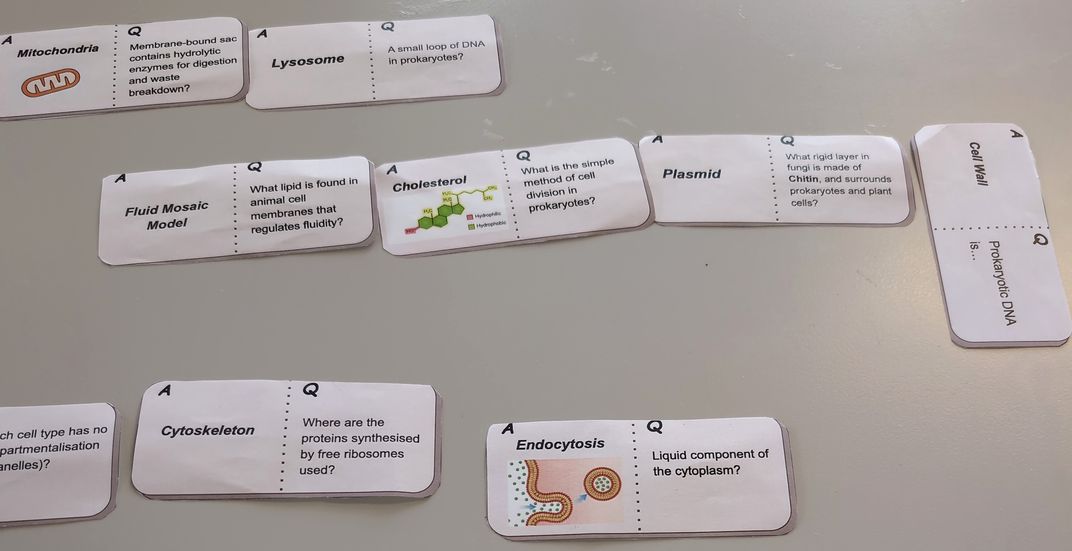
Each card has an answer on one half and a question on the other. Groups race to build one long chain, matching every question to the next card's answer.
The formative part is watching, not marking. Walk round and note where chains stall or cards get swapped back and forth: those gaps are your misconceptions. Cytosol versus cytoplasm, and plasmid versus nucleoid, are common ones.
Then the chat: each group picks the card they argued about most and explains it to the class. Ten minutes, no worksheet, and you know exactly what to reteach.
IB Biology: A2.2 Cell structure, B2.1 Membranes and membrane transport, B2.2 Organelles and compartmentalization.
AP Biology: Unit 2, Cell Structure and Function.
This set is from Rainy Day Biology, Book 1.
Rainy Day Biology free sample
Print-and-play activities from Book 1, each with a teacher key. Try a set in class before you buy.
Get the sampleRainy Day Biology, Book 1 from $19
21 activities in 8 game formats, dominoes included. Buying the first edition directly supports the site, and Books 2 and 3 are on the way.
Preview & buyYouTube Shorts as lesson hooks
Ask the question, play a 30-second Short, then build the lesson on the answer. The room is with you from the first minute.
Beans, bacteria and the gas
Raffinose slips past human enzymes, reaches the large intestine, and gets fermented. 34 seconds, zero shame.
Watch the ShortThe biology, and where it fits
Beans are rich in raffinose, a trisaccharide of galactose, glucose and fructose. Hydrolysing it needs the enzyme α-galactosidase, which we don't secrete into the gut, so raffinose reaches the large intestine intact. There, bacteria ferment it anaerobically, releasing hydrogen and carbon dioxide. In some people, archaea turn part of that into methane.
IB Biology: B1.1 Carbohydrates and lipids (hydrolysis of glycosidic bonds), C1.1 Enzymes and metabolism (specificity and the active site), C1.2 Cell respiration (anaerobic respiration, with bacterial fermentation as a comparison).
AP Biology: Topic 1.3 (hydrolysis), Topic 3.1 Enzyme Structure (specificity), Topic 3.6 Cellular Respiration (fermentation).
Try it as a starter: ask the class why we can't digest raffinose before playing the Short.
- The exam maker now marks papers with AI
The first 200 people to sign up get 10 free credits: enough for ten practice papers, or two drafts through the IA marker for moderation or student feedback. Tell your students!
- New simulators: transects, quadrats and cell signalling
All free, all on the labs page. Is there a simulator you wish existed? Hit reply and tell me.
See you in a fortnight,
Adam
Get the teacher incubator in your inbox
Classroom-ready ideas for IB & AP Biology teachers, every other Sunday: class activities, teaching resources and free stuff. Unsubscribe any time.