The subtopic in the middle and eleven tasks round it: label six diagrams, complete a table and fill 62 gaps. Every box is standard level. Type into the blanks and check them, or print it on A4, Letter or A3 with an answer key.
Paper
Each subtopic on a landscape page, as shuffled and chosen on screen.
B1.1
Carbohydrates and lipids
Molecules · Form and function
Hover over a box to see it. Untick it to leave it off this sheet and its printout.
Name
B1.1.2, B1.1.3Building and breaking
Polysaccharides, polypeptides and nucleic acids are polymers: chains of . Each link is made by a reaction, which releases a molecule of water. Digestion breaks the links again by : for each one a water molecule is split, its –H joining one of the freed units and its the other.
B1.1.6Cellulose fibres
123
1
2
3
Alternate monomers are turned , which keeps each chain . Chains lie side by side in bundles, cross-linked many times over, giving plant cell walls great .
B1.1.10Fatty acid tails
1234
1
2
3
4
Kinks stop the chains packing closely, so the more kinks, the the melting point. Plants store energy in , rich in kinked chains and liquid at room temperature; endotherms store it in , rich in straight chains and solid at room temperature.
B1.1.8, B1.1.11Fat stores
Lipids, among them fats, oils, waxes and steroids, dissolve in solvents but only sparingly in water. Triglycerides are stored in tissue. Gram for gram they release about as much energy as carbohydrates, and being hydrophobic they are stored without water, so the store is light. They conduct heat poorly, so a thick layer, such as a seal's , insulates an endotherm living in cold water.
B1.1.1Why carbon?
A covalent bond is a pair of electrons by two atoms. A carbon atom can form up to of them, as single or bonds, with other carbon atoms or with other non-metals such as hydrogen, oxygen and nitrogen. So carbon builds chains, or unbranched, and single or multiple : the frameworks of a vast diversity of compounds.
B1.1.4, B1.1.6Sugar rings
123
1
2
3
The two rings with six carbons are . Glucose is small and polar, so it is and easily carried in blood plasma. It is chemically , and its in respiration releases plenty of energy.
B1.1Carbohydrates and lipids
B1.1.7Cell name tags
A glycoprotein is a protein with chains attached. Facing out from the cell surface membrane, they let cells one another. The ABO blood groups are an example: red blood cells of group A carry the A , group AB carry both A and B, and group carry neither.
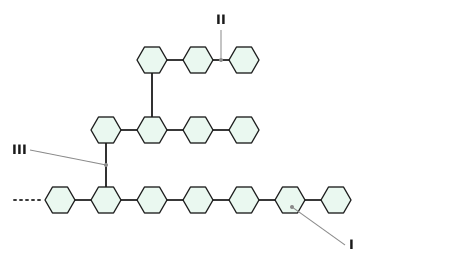
B1.1 examPart of a glycogen molecule from a liver cell
123
1
2
3
B1.1.5, B1.1.6Three polysaccharides
Monomer
Branches
Found in
Starch
some
plants
Glycogen
Cellulose
plant cell walls
Coiling and branching make starch and glycogen, the two energy stores, . Their huge molecules are almost , and monomers are easily added by condensation or released by as the store is built up or used.
B1.1.9Building lipids
1234
1
2
3
4
Each link is made by a reaction. The molecule on the left is a ; the one on the right, with its charged head, is a .
B1.1.12, B1.1.13Crossing the membrane
123
1
2
3
Phospholipids are : one part of each molecule is attracted to water and the other repelled by it. In water they arrange themselves as a . Non-polar hormones such as oestradiol and pass straight through it.
Every box on the sheet with its gaps filled in, as the subtopic reads in full.
GapsWhy carbon?
A covalent bond is a pair of electrons shared by two atoms. A carbon atom can form up to four of them, as single or double bonds, with other carbon atoms or with other non-metals such as hydrogen, oxygen and nitrogen. So carbon builds chains, branched or unbranched, and single or multiple rings: the frameworks of a vast diversity of compounds.
GapsBuilding and breaking
Polysaccharides, polypeptides and nucleic acids are polymers: chains of monomers. Each link is made by a condensation reaction, which releases a molecule of water. Digestion breaks the links again by hydrolysis: for each one a water molecule is split, its –H joining one of the freed units and its –OH the other.
LabelSugar rings
pentose
alpha-glucose
beta-glucose
The two rings with six carbons are hexoses. Glucose is small and polar, so it is soluble and easily carried in blood plasma. It is chemically stable, and its oxidation in respiration releases plenty of energy.
TableThree polysaccharides
Monomer
Branches
Found in
Starch
α-glucose
some
plants
Glycogen
α-glucose
more
animals
Cellulose
β-glucose
none
plant cell walls
Coiling and branching make starch and glycogen, the two energy stores, compact. Their huge molecules are almost insoluble, and monomers are easily added by condensation or released by hydrolysis as the store is built up or used.
LabelCellulose fibres
beta-glucose
glycosidic bond
hydrogen bond
Alternate monomers are turned upside down, which keeps each chain straight. Chains lie side by side in bundles, cross-linked many times over, giving plant cell walls great tensile strength.
GapsCell name tags
A glycoprotein is a protein with carbohydrate chains attached. Facing out from the cell surface membrane, they let cells recognise one another. The ABO blood groups are an example: red blood cells of group A carry the A antigen, group AB carry both A and B, and group O carry neither.
LabelBuilding lipids
glycerol
fatty acid
ester bond
phosphate group
Each link is made by a condensation reaction. The molecule on the left is a triglyceride; the one on the right, with its charged head, is a phospholipid.
LabelFatty acid tails
saturated
monounsaturated
polyunsaturated
double bond
Kinks stop the chains packing closely, so the more kinks, the lower the melting point. Plants store energy in oils, rich in kinked chains and liquid at room temperature; endotherms store it in fats, rich in straight chains and solid at room temperature.
GapsFat stores
Lipids, among them fats, oils, waxes and steroids, dissolve in non-polar solvents but only sparingly in water. Triglycerides are stored in adipose tissue. Gram for gram they release about twice as much energy as carbohydrates, and being hydrophobic they are stored without water, so the store is light. They conduct heat poorly, so a thick layer, such as a seal's blubber, insulates an endotherm living in cold water.
LabelCrossing the membrane
hydrophilic head
hydrophobic tails
steroid
Phospholipids are amphipathic: one part of each molecule is attracted to water and the other repelled by it. In water they arrange themselves as a bilayer. Non-polar hormones such as oestradiol and testosterone pass straight through it.
Exam diagramPart of a glycogen molecule from a liver cell
 Biology by Bradford
 123
123