B1.2.1An amino acid
1234
- 1
- 2
- 3
- 4
 Biology by Bradford
support
Biology by Bradford
support
The subtopic in the middle and ten tasks round it: label four diagrams, complete two tables, put a process in order and fill 49 gaps. Every standard level statement has a box; the five boxes for higher level only are dashed and badged HL, and drop off for an SL class. Type into the blanks and check them, or print it on A4, Letter or A3 with an answer key.
This folding of the whole chain is the structure. Only one of the four links shown is covalent: it joins the R-groups of two amino acids. Amine and carboxyl groups in R-groups become charged by gaining or losing .
| Polypeptide chains | Shape | |
|---|---|---|
| Insulin | 2 | |
| Collagen | ||
| Haemoglobin |
Haemoglobin is a protein: each of its chains carries a non-polypeptide group. Insulin and collagen are not. Compact and soluble, insulin travels in the blood to its target cells; the long, rope-like chains of collagen give to skin, tendons and bone.
Two amino acids link in a reaction: amino acid + amino acid → + . The shaded bond, from the carbon of one to the nitrogen of the next, is a . More links like it build a .
Amino acids the body cannot make for itself are : they must come from food. amino acids can be made from other amino acids. Some plant foods are low in one or more of the first kind, so a diet needs a varied mix of protein sources.
Every R-group is either hydrophobic or ; the second kind are either or charged, and charged ones are acidic or . In a protein dissolved in water, hydrophobic R-groups cluster in the , away from water, while an integral protein has bands of them where it sits in the .
 1234
1234| Amino acids in the chain | Possible sequences |
|---|---|
| 1 | 20 |
| 2 | |
| 3 | |
| n |
Chains run from a few amino acids to many , in any order, so the number of possible polypeptides is practically .
Number the steps in order.
This change is . Extremes of cause it too, by altering the charges on R-groups.
The order of amino acids, the structure, decides where these folds form and how the whole chain folds up, so every copy of a protein has the same precise . These folds are its structure, held by bonds between C=O and N–H groups at regular intervals.
Two amino acids link in a condensation reaction: amino acid + amino acid → dipeptide + water. The shaded bond, from the carbon of one to the nitrogen of the next, is a peptide bond. More links like it build a polypeptide.
Amino acids the body cannot make for itself are essential: they must come from food. Non-essential amino acids can be made from other amino acids. Some plant foods are low in one or more of the first kind, so a vegan diet needs a varied mix of protein sources.
| Amino acids in the chain | Possible sequences |
|---|---|
| 1 | 20 |
| 2 | 400 |
| 3 | 8000 |
| n | 20ⁿ |
Chains run from a few amino acids to many thousands, in any order, so the number of possible polypeptides is practically infinite.
This change is denaturation. Extremes of pH cause it too, by altering the charges on R-groups.
Every R-group is either hydrophobic or hydrophilic; the second kind are either polar or charged, and charged ones are acidic or basic. In a protein dissolved in water, hydrophobic R-groups cluster in the core, away from water, while an integral protein has bands of them where it sits in the membrane.
The order of amino acids, the primary structure, decides where these folds form and how the whole chain folds up, so every copy of a protein has the same precise shape. These folds are its secondary structure, held by bonds between C=O and N–H groups at regular intervals.
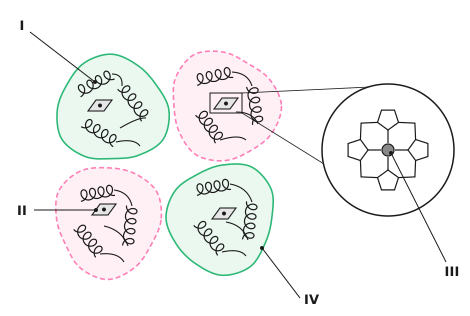
This folding of the whole chain is the tertiary structure. Only one of the four links shown is covalent: it joins the R-groups of two cysteine amino acids. Amine and carboxyl groups in R-groups become charged by gaining or losing H⁺.
| Polypeptide chains | Shape | |
|---|---|---|
| Insulin | 2 | globular |
| Collagen | 3 | fibrous |
| Haemoglobin | 4 | globular |
Haemoglobin is a conjugated protein: each of its chains carries a non-polypeptide haem group. Insulin and collagen are not. Compact and soluble, insulin travels in the blood to its target cells; the long, rope-like chains of collagen give tensile strength to skin, tendons and bone.