The subtopic in the middle and eight tasks round it: label three diagrams, complete a table, put a process in order and fill 35 gaps. The whole subtopic is higher level. Type into the blanks and check them, or print it on A4, Letter or A3 with an answer key.
Paper
Each subtopic on a landscape page, as shuffled and chosen on screen.
A3.2
Classification and cladistics
Organisms · Unity and diversity
Hover over a box to see it. Untick it to leave it off this sheet and its printout.
Name
A3.2.2Ranks within ranksHL
123
1
2
3
Each rank of the traditional hierarchy holds the ranks below it. Fixed ranks are : variation is a gradual spread rather than neat levels, and the ranks do not always match how lineages diverged in evolution. Cladistics offers unranked clades instead, an example of a in science.
A3.2.5Reading the molecular clockHL
Species compared
Base differences
Split, millions of years ago
P and Q
4
Q and R
20
P and S
15
R and S
30
Sample data: two species differ in this gene by about one more base for every 2 million years since they split. The clock only gives estimates, as the rate of change depends on the , population size and the strength of selection.
A3.2.8The figwort familyHL
Plants were placed in the figwort family because their flowers looked alike: the grouping rested on . Cladistic analysis of their gene showed that many did not share a recent common ancestor; their likeness came from . Fewer than half of the species stayed in the family, and foxgloves and snapdragons were among those moved. A classification once accepted had been .
A3.2.7Reading a cladogramHL
Each place where a lineage splits stands for a hypothetical . The more the ancestor two species share, the more closely related they are, so the closest relatives of birds here are . The traditional class of reptiles leaves birds out, so it is not a .
A3.2Classification and cladistics
A3.2.9The tree of lifeHL
123
1
2
3
Base sequences of showed that prokaryotes form two very different groups. So in 1977 a new level was proposed above the , and every organism now sits in one of three .
A3.2.1, A3.2.3Why classify?HL
About two million species have been named and many more await discovery. Classification is needed because of this immense , and once it is done a broad range of further study becomes possible. The ideal classification follows , so every member of a group descends from one . Features found in some members can then be in others, because they are shared within the clade.
A3.2.4, A3.2.6Building a cladogramHL
Number the steps in order.
Choose a gene, or a protein, that every species in the study has.
Count the differences between each pair of species.
Line the sequences up, position by position.
Pick the tree that explains the differences with the fewest changes.
Find its sequence in each species.
Base sequences of genes and sequences of proteins are the most objective evidence for placing organisms in a clade, though traits can be used too. Choosing the tree with the fewest changes is : it gives the most probable cladogram, still a hypothesis.
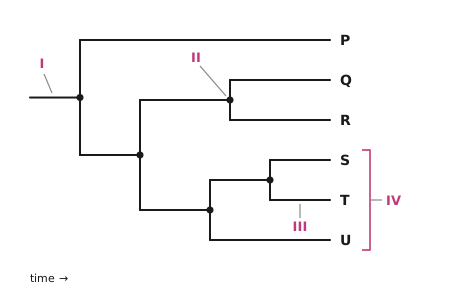
A3.2 examA cladogram for six species, P to UHL
1234
1
2
3
4
Word bank1015308amino acidarbitraryArchaeaBacteriacladecommon ancestorconvergent evolutioncrocodilesdiversitydomainsEukaryaevolutionary relationshipsfalsifiedgeneration timegenuskingdommorphologicalmorphologynodeorderparadigm shiftparsimonyphylumpredictedrecentribosomal RNArootsequencesterminal branch
Answer key
Every box on the sheet with its gaps filled in, as the subtopic reads in full.
GapsWhy classify? HL
About two million species have been named and many more await discovery. Classification is needed because of this immense diversity, and once it is done a broad range of further study becomes possible. The ideal classification follows evolutionary relationships, so every member of a group descends from one common ancestor. Features found in some members can then be predicted in others, because they are shared within the clade.
LabelRanks within ranks HL
phylum
order
genus
Each rank of the traditional hierarchy holds the ranks below it. Fixed ranks are arbitrary: variation is a gradual spread rather than neat levels, and the ranks do not always match how lineages diverged in evolution. Cladistics offers unranked clades instead, an example of a paradigm shift in science.
GapsReading a cladogram HL
Each place where a lineage splits stands for a hypothetical common ancestor. The more recent the ancestor two species share, the more closely related they are, so the closest relatives of birds here are crocodiles. The traditional class of reptiles leaves birds out, so it is not a clade.
OrderBuilding a cladogram HL
Choose a gene, or a protein, that every species in the study has.
Find its sequence in each species.
Line the sequences up, position by position.
Count the differences between each pair of species.
Pick the tree that explains the differences with the fewest changes.
Base sequences of genes and amino acid sequences of proteins are the most objective evidence for placing organisms in a clade, though morphological traits can be used too. Choosing the tree with the fewest changes is parsimony: it gives the most probable cladogram, still a hypothesis.
TableReading the molecular clock HL
Species compared
Base differences
Split, millions of years ago
P and Q
4
8
Q and R
10
20
P and S
15
30
R and S
15
30
Sample data: two species differ in this gene by about one more base for every 2 million years since they split. The clock only gives estimates, as the rate of change depends on the generation time, population size and the strength of selection.
GapsThe figwort family HL
Plants were placed in the figwort family because their flowers looked alike: the grouping rested on morphology. Cladistic analysis of their gene sequences showed that many did not share a recent common ancestor; their likeness came from convergent evolution. Fewer than half of the species stayed in the family, and foxgloves and snapdragons were among those moved. A classification once accepted had been falsified.
LabelThe tree of life HL
Bacteria
Archaea
Eukarya
Base sequences of ribosomal RNA showed that prokaryotes form two very different groups. So in 1977 a new level was proposed above the kingdom, and every organism now sits in one of three domains.
Exam diagramA cladogram for six species, P to U HL
 Biology by Bradford
 1234
1234