The subtopic in the middle and eleven tasks round it: label four diagrams, complete two tables, put a process in order and fill 53 gaps. Every standard level statement has a box; the three boxes for higher level only are dashed and badged HL, and drop off for an SL class. Type into the blanks and check them, or print it on A4, Letter or A3 with an answer key.
Paper
Each subtopic on a landscape page, as shuffled and chosen on screen.
A4.1
Evolution and speciation
Ecosystems · Unity and diversity
Hover over a box to see it. Untick it to leave it off this sheet and its printout.
Name
A4.1.2Counting differences
The chart counts the differences between human haemoglobin β and the same protein in other vertebrates. Bases in DNA or RNA, and in proteins, can be compared like this. The fewer the differences, the more two species shared an ancestor, so of these species humans are most closely related to the . Similar sequences across all of life are strong evidence of .
A4.1.3Bred by humans
In selective breeding, humans rather than the environment decide which individuals reproduce: . Cabbage, kale, broccoli and cauliflower were all bred from a single wild . Most dog breeds were created in the last two hundred years, yet they vary more in size and skull shape than all the wild members of the dog family. Large evolutionary change can therefore be .
A4.1.4One bone plan
12345
1
2
3
4
5
A human arm, a bat's wing and a whale's flipper do different jobs, yet they have the same bones in the same order (matched here by colour): all are limbs. The best explanation is that all three were inherited from a .
A4.1.8, A4.1.10Kept apartHL
Isolation
What stops interbreeding
Speciation it leads to
Geographic
a river, mountain range or sea divides the groups
Behavioural
different songs or displays, so mates are not recognised
Temporal
mating or flowering at different
Both kinds of speciation need followed by divergence; they differ in whether the groups share one place. A hybrid that does form is often , like the mule, a cross of a horse and a donkey, so alleles still cannot pass from one species to the other.
A4.1.4, A4.1.5Homologous or analogous?
Homologous structures
Analogous structures
Evolutionary origin
Function
may differ
Example
the forelimbs of a bat and a whale
the wings of a bird and an insect
Arise by
divergence into new uses
evolution
A4.1.7Either side of the river
123
1
2
3
Neither ape can swim, so the river keeps the two populations apart and stops between them. Conditions differ on the two banks, so different traits were favoured on each side: . Over many generations the populations into two species.
A4.1Evolution and speciation
A4.1.9Many from oneHL
When one ancestral species gives rise to many, each adapted to a different , it is an . Darwin's finches on the Galápagos are an example, their beaks suited to different foods. Using different resources, the new species can live side by side without . This happens most where ways of life are , as on new islands, and it raises biodiversity.
A4.1.1What counts as evolution
Evolution is change in the characteristics of a over generations. Lamarck thought that characteristics during an organism's life, such as a giraffe's neck stretched by reaching for leaves, were passed on to its offspring. Changes that are not genetic in origin are not evolution. Natural selection explains and predicts so much that it is unlikely ever to be falsified, yet it can never be formally proved: it is a .
A4.1.6, A4.1.7One species becomes two
Number the steps in order.
Each group faces different selection pressures, so different alleles are favoured.
No genes pass between the two groups: they are reproductively isolated.
Over many generations the two gene pools become more and more different.
Even if the barrier goes, the groups cannot interbreed to give fertile offspring: they are now separate species.
A barrier such as a river or mountain range divides a population in two.
Splitting is the only way new species arise. It the number of species on Earth, while reduces it. A species that changes gradually over time without dividing has evolved, but this is not .
A4.1.11A plant's shortcutHL
123
1
2
3
Speciation by this route is , needing no . The new plant breeds with others like it, but its offspring with either would be sterile. Many species in the knotweed and smartweed genus, , arose this way.
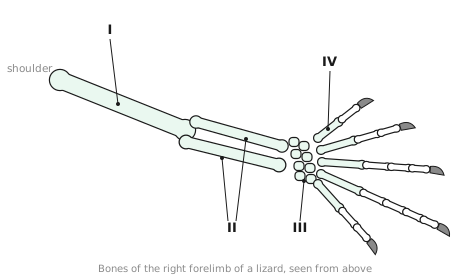
A4.1 examThe bones of the right forelimb of a lizard
1234
1
2
3
4
Word bankabruptacquiredadaptive radiationallopatricamino acidsartificial selectionbonobocarpalschromosome doublingcommon ancestorcommon ancestrycommon chimpanzeecompetingCongo Riverconvergentcourtshipdifferentdifferential selectiondivergedextinctiongene flowgeographical isolationgorillaheritablehumerushybridincreasesmetacarpalmetacarpalsnicheparentpentadactylPersicariaphalangespolyploidpopulationradius and ulnarapidrecentlyreproductive isolationspeciationspeciessterilesympatricthe sametheorytimesvacant
Answer key
Every box on the sheet with its gaps filled in, as the subtopic reads in full.
GapsWhat counts as evolution
Evolution is change in the heritable characteristics of a population over generations. Lamarck thought that characteristics acquired during an organism's life, such as a giraffe's neck stretched by reaching for leaves, were passed on to its offspring. Changes that are not genetic in origin are not evolution. Natural selection explains and predicts so much that it is unlikely ever to be falsified, yet it can never be formally proved: it is a theory.
GapsCounting differences
The chart counts the differences between human haemoglobin β and the same protein in other vertebrates. Bases in DNA or RNA, and amino acids in proteins, can be compared like this. The fewer the differences, the more recently two species shared an ancestor, so of these species humans are most closely related to the gorilla. Similar sequences across all of life are strong evidence of common ancestry.
GapsBred by humans
In selective breeding, humans rather than the environment decide which individuals reproduce: artificial selection. Cabbage, kale, broccoli and cauliflower were all bred from a single wild species. Most dog breeds were created in the last two hundred years, yet they vary more in size and skull shape than all the wild members of the dog family. Large evolutionary change can therefore be rapid.
LabelOne bone plan
humerus
radius and ulna
carpals
metacarpals
phalanges
A human arm, a bat's wing and a whale's flipper do different jobs, yet they have the same bones in the same order (matched here by colour): all are pentadactyl limbs. The best explanation is that all three were inherited from a common ancestor.
TableHomologous or analogous?
Homologous structures
Analogous structures
Evolutionary origin
the same
different
Function
may differ
the same
Example
the forelimbs of a bat and a whale
the wings of a bird and an insect
Arise by
divergence into new uses
convergent evolution
LabelEither side of the river
Congo River
common chimpanzee
bonobo
Neither ape can swim, so the river keeps the two populations apart and stops gene flow between them. Conditions differ on the two banks, so different traits were favoured on each side: differential selection. Over many generations the populations diverged into two species.
OrderOne species becomes two
A barrier such as a river or mountain range divides a population in two.
No genes pass between the two groups: they are reproductively isolated.
Each group faces different selection pressures, so different alleles are favoured.
Over many generations the two gene pools become more and more different.
Even if the barrier goes, the groups cannot interbreed to give fertile offspring: they are now separate species.
Splitting is the only way new species arise. It increases the number of species on Earth, while extinction reduces it. A species that changes gradually over time without dividing has evolved, but this is not speciation.
TableKept apart HL
Isolation
What stops interbreeding
Speciation it leads to
Geographic
a river, mountain range or sea divides the groups
allopatric
Behavioural
different courtship songs or displays, so mates are not recognised
sympatric
Temporal
mating or flowering at different times
sympatric
Both kinds of speciation need reproductive isolation followed by divergence; they differ in whether the groups share one place. A hybrid that does form is often sterile, like the mule, a cross of a horse and a donkey, so alleles still cannot pass from one species to the other.
GapsMany from one HL
When one ancestral species gives rise to many, each adapted to a different niche, it is an adaptive radiation. Darwin's finches on the Galápagos are an example, their beaks suited to different foods. Using different resources, the new species can live side by side without competing. This happens most where ways of life are vacant, as on new islands, and it raises biodiversity.
LabelA plant's shortcut HL
hybrid
chromosome doubling
polyploid
Speciation by this route is abrupt, needing no geographical isolation. The new plant breeds with others like it, but its offspring with either parent would be sterile. Many species in the knotweed and smartweed genus, Persicaria, arose this way.
Exam diagramThe bones of the right forelimb of a lizard
 Biology by Bradford
 1234
1234