The subtopic in the middle and ten tasks round it: label four diagrams, complete two tables, put a process in order and fill 46 gaps. Every box is standard level. Type into the blanks and check them, or print it on A4, Letter or A3 with an answer key.
Paper
Each subtopic on a landscape page, as shuffled and chosen on screen.
B4.1
Adaptation to environment
Ecosystems · Form and function
Hover over a box to see it. Untick it to leave it off this sheet and its printout.
Name
B4.1.1Where it lives
A is the place where an organism, population, species or community lives. A full description gives its location (the part of the world), its physical location and the type of : the common limpet lives on rocky shores of north-west Europe, clinging to rocks between high and low tide.
B4.1.2Life in a mangrove swamp
123
1
2
3
Mangrove swamps fringe tropical coasts. Their mud is waterlogged, so it holds little , and the water is . Red mangrove (Rhizophora mangle) stands on arching roots that brace it in soft mud, and its seeds germinate while still on the tree. Grey mangrove (Avicennia marina) takes in air through roots that grow up out of the mud, and gets rid of excess salt through on its leaves.
B4.1.5What reefs need
Factor
Needed for reef growth
Why it matters
Water depth
shallow, mostly less than 50 m
the algae living in the coral need for photosynthesis
Clarity
clear water, low
suspended sediment blocks light and smothers the polyps
Temperature
, about 23 to 29 °C
growth slows in colder water; hotter water stresses the corals
Salinity
close to that of the open sea
reefs are absent near river mouths, where dilutes the sea
pH
slightly , about 8.2
calcium carbonate skeletons are laid down more easily
B4.1.7Far apart, look alike
A is a group of ecosystems with similar communities, found wherever the abiotic conditions, above all the climate, are alike. Unrelated species in the same biome on different continents often look similar through : American cacti and African euphorbias both have swollen green stems that store water. Tundra is cold all year over permanently frozen ground; taiga has long freezing winters, and much of its precipitation falls as .
B4.1.2Marram grass
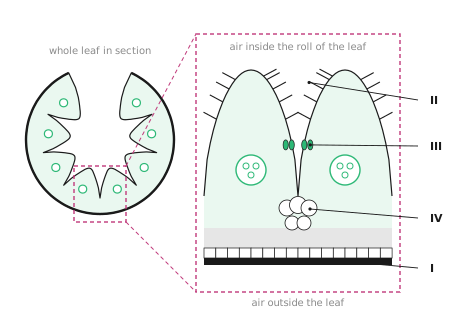
Marram grass (Ammophila arenaria) holds coastal , where rain drains away fast and the wind is drying. In dry air its leaves roll up, trapping air so less water is lost by . When blown sand buries it, underground stems called grow up through the sand, and its roots grow long and deep to reach water far below.
B4.1.4Running a transect
Number the steps in order.
Run a tape measure along the line.
Place a quadrat at regular intervals along the tape, such as every 5 m.
Choose a line across a habitat where an abiotic variable changes, such as from the strandline inland over sand dunes.
In each quadrat, estimate the percentage cover of the species and measure the variable with a sensor, such as a pH probe or light meter.
Plot the species’ cover against the variable and test the strength of the correlation.
Placing the quadrats at fixed intervals avoids . A strong correlation suggests a link, but on its own it does not prove .
B4.1Adaptation to environment
B4.1.8Hot and dry, hot and wet
Species
Adaptation
How it helps
Saguaro cactus, hot desert
leaves reduced to ; stomata open only at
little water is lost: no broad leaves, and gas exchange happens when it is cool
Fennec fox, hot desert
very large, thin
radiate body heat; also pick up prey moving under the sand
Kapok tree, tropical rainforest
wide at the base of the trunk
hold up a very tall tree rooted in shallow soil
Spider monkey, tropical rainforest
a long tail that grips
a fifth limb for climbing and hanging in the canopy
Many rainforest leaves end in a pointed that sheds rainwater quickly.
B4.1.3, B4.1.4How much is too much?
1234
1
2
3
4
Abiotic variables such as temperature, light intensity and soil pH for a plant, or temperature and dissolved oxygen for an animal, affect where a species is found. A variable that goes beyond what the species can survive is the , setting the edge of its .
B4.1.6, B4.1.7Temperature and rainfall
12345
1
2
3
4
5
For any pattern of temperature and rainfall, one type of natural is likely to develop. Where it is too dry for forest but wetter than desert, the result is .
B4.1 examMarram grass (Ammophila arenaria) grows on coastal sand dunes
1234
1
2
3
4
Word bankalkalinebiasbiomebuttress rootscausationconvergent evolutioncuticledistributiondrip tipearsecosystemfresh watergeographicalgrasslandhabitathairhinge cellshot deserthumidlightlimiting factornightoptimum rangeoxygenpneumatophoresprehensileprop rootspropagulerange of tolerancerhizomessalt glandssaltysand dunessnowspinesstomataigatemperate foresttranspirationtropical rainforesttundraturbiditywarmzone of intolerancezone of stress
Answer key
Every box on the sheet with its gaps filled in, as the subtopic reads in full.
GapsWhere it lives
A habitat is the place where an organism, population, species or community lives. A full description gives its geographical location (the part of the world), its physical location and the type of ecosystem: the common limpet lives on rocky shores of north-west Europe, clinging to rocks between high and low tide.
GapsMarram grass
Marram grass (Ammophila arenaria) holds coastal sand dunes, where rain drains away fast and the wind is drying. In dry air its leaves roll up, trapping humid air so less water is lost by transpiration. When blown sand buries it, underground stems called rhizomes grow up through the sand, and its roots grow long and deep to reach water far below.
LabelLife in a mangrove swamp
prop roots
pneumatophores
propagule
Mangrove swamps fringe tropical coasts. Their mud is waterlogged, so it holds little oxygen, and the water is salty. Red mangrove (Rhizophora mangle) stands on arching roots that brace it in soft mud, and its seeds germinate while still on the tree. Grey mangrove (Avicennia marina) takes in air through roots that grow up out of the mud, and gets rid of excess salt through salt glands on its leaves.
LabelHow much is too much?
optimum range
zone of stress
zone of intolerance
range of tolerance
Abiotic variables such as temperature, light intensity and soil pH for a plant, or temperature and dissolved oxygen for an animal, affect where a species is found. A variable that goes beyond what the species can survive is the limiting factor, setting the edge of its distribution.
OrderRunning a transect
Choose a line across a habitat where an abiotic variable changes, such as from the strandline inland over sand dunes.
Run a tape measure along the line.
Place a quadrat at regular intervals along the tape, such as every 5 m.
In each quadrat, estimate the percentage cover of the species and measure the variable with a sensor, such as a pH probe or light meter.
Plot the species’ cover against the variable and test the strength of the correlation.
Placing the quadrats at fixed intervals avoids bias. A strong correlation suggests a link, but on its own it does not prove causation.
TableWhat reefs need
Factor
Needed for reef growth
Why it matters
Water depth
shallow, mostly less than 50 m
the algae living in the coral need light for photosynthesis
Clarity
clear water, low turbidity
suspended sediment blocks light and smothers the polyps
Temperature
warm, about 23 to 29 °C
growth slows in colder water; hotter water stresses the corals
Salinity
close to that of the open sea
reefs are absent near river mouths, where fresh water dilutes the sea
pH
slightly alkaline, about 8.2
calcium carbonate skeletons are laid down more easily
LabelTemperature and rainfall
tundra
taiga
temperate forest
hot desert
tropical rainforest
For any pattern of temperature and rainfall, one type of natural ecosystem is likely to develop. Where it is too dry for forest but wetter than desert, the result is grassland.
GapsFar apart, look alike
A biome is a group of ecosystems with similar communities, found wherever the abiotic conditions, above all the climate, are alike. Unrelated species in the same biome on different continents often look similar through convergent evolution: American cacti and African euphorbias both have swollen green stems that store water. Tundra is cold all year over permanently frozen ground; taiga has long freezing winters, and much of its precipitation falls as snow.
TableHot and dry, hot and wet
Species
Adaptation
How it helps
Saguaro cactus, hot desert
leaves reduced to spines; stomata open only at night
little water is lost: no broad leaves, and gas exchange happens when it is cool
Fennec fox, hot desert
very large, thin ears
radiate body heat; also pick up prey moving under the sand
Kapok tree, tropical rainforest
wide buttress roots at the base of the trunk
hold up a very tall tree rooted in shallow soil
Spider monkey, tropical rainforest
a long prehensile tail that grips
a fifth limb for climbing and hanging in the canopy
Many rainforest leaves end in a pointed drip tip that sheds rainwater quickly.
Exam diagramMarram grass (Ammophila arenaria) grows on coastal sand dunes
 Biology by Bradford
 1234
1234