The subtopic in the middle and nine tasks round it: label five diagrams, complete a table, put a process in order and fill 42 gaps. The whole subtopic is higher level. Type into the blanks and check them, or print it on A4, Letter or A3 with an answer key.
Paper
Each subtopic on a landscape page, as shuffled and chosen on screen.
B3.3
Muscle and motility
Organisms · Form and function
Hover over a box to see it. Untick it to leave it off this sheet and its printout.
Name
B3.3.1, B3.3.9Why move?HL
Example
Reason for moving
A cheetah sprinting after a gazelle
A gazelle zig-zagging away from the cheetah
A male moth flying upwind towards a female's scent
Arctic terns flying between the Arctic and the Antarctic each year
A species moves from place to place; a one, such as a coral or a barnacle, stays fixed but still moves parts of itself.
B3.3.2Sliding filamentsHL
Number the steps in order.
The ATP is hydrolysed, and the energy re-cocks the head, ready to bind further along.
A nerve impulse arrives, and calcium ions released inside the fibre expose binding sites on the actin.
Myosin heads bind to the actin, forming cross-bridges.
ATP binds to each myosin head, which lets go of the actin.
The heads swivel, pulling the actin towards the middle of the sarcomere: the power stroke.
B3.3.6The hip jointHL
12345
1
2
3
4
5
Muscles pull on the bones through . The hip is a joint, so it can move in all three planes.
B3.3.4Nerve to muscleHL
123
1
2
3
One of these nerve cells and all the cells it supplies form a : when it fires, they all contract together. Muscles that make fine movements, such as those that move the eye, have units.
B3.3Muscle and motility
B3.3.5, B3.3.7Skeletons at workHL
Arthropods have a hard outside the body; vertebrates have an of bone inside it. Either way the skeleton anchors the muscles, and its parts act as that turn about the joints. The angle a joint can move through, its range of motion, is measured in degrees with a or from photos analysed on a computer.
B3.3 examOne sarcomere from a relaxed myofibrilHL
1234
1
2
3
4
B3.3.2, B3.3.3A sarcomereHL
1234
1
2
3
4
When the muscle contracts, the two kinds of filament past each other and the sarcomere ; neither kind of filament changes length.
B3.3.3, B3.3.8Pulling in pairsHL
Muscle exerts force only when it : it can pull but never push. So muscles work in pairs: when one pulls, it stretches the other. Between the ribs, the and external intercostal muscles have fibres running in different directions, so they move the ribcage in opposite directions. The stretched layer stores in the giant protein , which helps its sarcomeres recoil and stops them overstretching.
B3.3.10Built for the seaHL
123
1
2
3
A body cuts drag. The tail beats , not side to side as a fish's does, and the airway opens on top of the head, so a dolphin can breathe at the surface between dives.
Word bankactinantagonisticball-and-socketblowholecartilagecontractsendoskeletonescaping dangerexoskeletonfemurflipperflukeforaginggoniometerinternalleversligamentlight bandmigrationmotilemotor neuronmotor unitmuscle fibremyosinneuromuscular junctionpelvispotential energysearching for a matesessileshortensslidesmallstreamlinedsynovial fluidtendonstitinup and downZ lineZ-disc
Answer key
Every box on the sheet with its gaps filled in, as the subtopic reads in full.
TableWhy move? HL
Example
Reason for moving
A cheetah sprinting after a gazelle
foraging
A gazelle zig-zagging away from the cheetah
escaping danger
A male moth flying upwind towards a female's scent
searching for a mate
Arctic terns flying between the Arctic and the Antarctic each year
migration
A motile species moves from place to place; a sessile one, such as a coral or a barnacle, stays fixed but still moves parts of itself.
LabelA sarcomere HL
Z line
actin
myosin
titin
When the muscle contracts, the two kinds of filament slide past each other and the sarcomere shortens; neither kind of filament changes length.
OrderSliding filaments HL
A nerve impulse arrives, and calcium ions released inside the fibre expose binding sites on the actin.
Myosin heads bind to the actin, forming cross-bridges.
The heads swivel, pulling the actin towards the middle of the sarcomere: the power stroke.
ATP binds to each myosin head, which lets go of the actin.
The ATP is hydrolysed, and the energy re-cocks the head, ready to bind further along.
GapsPulling in pairs HL
Muscle exerts force only when it contracts: it can pull but never push. So muscles work in antagonistic pairs: when one pulls, it stretches the other. Between the ribs, the internal and external intercostal muscles have fibres running in different directions, so they move the ribcage in opposite directions. The stretched layer stores potential energy in the giant protein titin, which helps its sarcomeres recoil and stops them overstretching.
LabelNerve to muscle HL
motor neuron
neuromuscular junction
muscle fibre
One of these nerve cells and all the cells it supplies form a motor unit: when it fires, they all contract together. Muscles that make fine movements, such as those that move the eye, have small units.
LabelThe hip joint HL
pelvis
femur
cartilage
synovial fluid
ligament
Muscles pull on the bones through tendons. The hip is a ball-and-socket joint, so it can move in all three planes.
GapsSkeletons at work HL
Arthropods have a hard exoskeleton outside the body; vertebrates have an endoskeleton of bone inside it. Either way the skeleton anchors the muscles, and its parts act as levers that turn about the joints. The angle a joint can move through, its range of motion, is measured in degrees with a goniometer or from photos analysed on a computer.
LabelBuilt for the sea HL
blowhole
flipper
fluke
A streamlined body cuts drag. The tail beats up and down, not side to side as a fish's does, and the airway opens on top of the head, so a dolphin can breathe at the surface between dives.
Exam diagramOne sarcomere from a relaxed myofibril HL
 Biology by Bradford
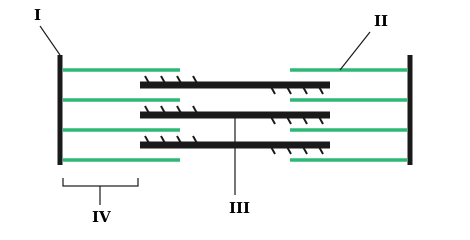 1234
1234