The subtopic in the middle and eleven tasks round it: label three diagrams, complete two tables, put a process in order and fill 48 gaps. Every box is standard level. Type into the blanks and check them, or print it on A4, Letter or A3 with an answer key.
Paper
Each subtopic on a landscape page, as shuffled and chosen on screen.
B4.2
Ecological niches
Ecosystems · Form and function
Hover over a box to see it. Untick it to leave it off this sheet and its printout.
Name
B4.2.8Skulls and diet
1234
1
2
3
4
Paranthropus robustus ground tough plant food between huge, thick-enamelled teeth at the back of its jaw, worked by big muscles anchored to its skull: a diet. Homo sapiens has smaller teeth and no ridge along its skull, suiting an diet. No one can watch an extinct species eat, so its diet is using theories built by studying mammals.
B4.2.10Hunters and hunted
Predator
Prey
Chemical
rattlesnake: injects through hollow fangs
poison dart frog: toxic skin, shown off by bright colours
Physical
rattlesnake: pit organs sense the heat of warm prey in the dark
stick insect: a twig-like shape and colour give it
Behavioural
wolves: hunt in packs to bring down large prey
meerkats: one keeps watch and gives
B4.2.13One niche, one species
Gause grew two Paramecium species on the same food. Alone, each thrived; together, P. caudatum was . Two species cannot share one niche for long: the principle of . The other possible outcome is that both survive, each to part of the niche it could fill alone, so every species’ niche is .
B4.2.1A species’ role
A species’ is the role it plays in its ecosystem. It covers where the species lives, how it obtains , and all its interactions with other organisms () and with non-living conditions () that affect its growth, survival and reproduction.
B4.2.3, B4.2.5, B4.2.6, B4.2.7Ways to feed
Nutrition
Found in
Energy from
Photosynthesis
plants, algae and some
light
Mixotrophic
some protists, such as
light, and organic food from its surroundings
Saprotrophic
some fungi and bacteria:
dead organic matter, digested by secreted enzymes
In archaea
one of the three domains of life
light, or oxidising chemicals or carbon compounds
A mixotroph that cannot grow without both modes is ; one that can survive on either mode alone is .
B4.2Ecological niches
B4.2.11Reaching the light
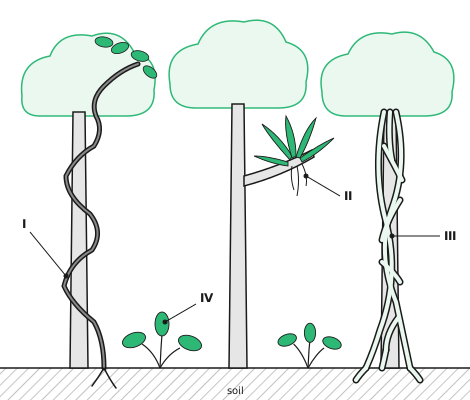
Light is what forest plants compete for, and little of it gets through the leaves above. Canopy trees spend years growing a tall woody before their leaves reach full sun. Woody climbers rooted on the forest floor use other trees for , so they build little wood of their own. Plants perched on high branches take water from rain and mist rather than from the ; one kind sends roots down to the ground and slowly wraps its host. Short plants below survive in deep .
B4.2 examA side view of part of a tropical rainforest
1234
1
2
3
4
B4.2.2Where microbes grow
123
1
2
3
Oxygen dissolves in at the surface, so its concentration falls down each tube of broth. To some microbes oxygen is ; others cannot release enough energy without ; a third group can respire either way.
B4.2.4Holozoic nutrition
Number the steps in order.
Ingestion: food is taken into the gut.
Assimilation: absorbed molecules are taken up by cells and built into the body’s own tissues.
Absorption: the small molecules pass through the gut wall into the blood.
Egestion: undigested matter leaves the body as faeces.
Digestion: enzymes hydrolyse large food molecules into small, soluble ones.
All animals are : they get their carbon compounds by feeding on other organisms.
B4.2.9Plants under attack
Leaf-eating insects feed in two ways: aphids tap the sap in leaf veins with mouthparts, and caterpillars cut off pieces of leaf with ones. Plants resist with physical structures such as and with toxic in their leaves and seeds. Koalas can live on eucalyptus leaves because their liver can its toxins.
B4.2.12Barnacles on a shore
Bar A shows where Chthamalus barnacles can live when Balanus is cleared away: their , set by their adaptations and tolerance limits. Bar B shows where they actually live alongside Balanus: their , narrowed by .
Every box on the sheet with its gaps filled in, as the subtopic reads in full.
GapsA species’ role
A species’ ecological niche is the role it plays in its ecosystem. It covers where the species lives, how it obtains food, and all its interactions with other organisms (biotic) and with non-living conditions (abiotic) that affect its growth, survival and reproduction.
LabelWhere microbes grow
facultative anaerobe
obligate aerobe
obligate anaerobe
Oxygen dissolves in at the surface, so its concentration falls down each tube of broth. To some microbes oxygen is toxic; others cannot release enough energy without aerobic respiration; a third group can respire either way.
TableWays to feed
Nutrition
Found in
Energy from
Photosynthesis
plants, algae and some prokaryotes
light
Mixotrophic
some protists, such as Euglena
light, and organic food from its surroundings
Saprotrophic
some fungi and bacteria: decomposers
dead organic matter, digested by secreted enzymes
In archaea
one of the three domains of life
light, or oxidising inorganic chemicals or carbon compounds
A mixotroph that cannot grow without both modes is obligate; one that can survive on either mode alone is facultative.
OrderHolozoic nutrition
Ingestion: food is taken into the gut.
Digestion: enzymes hydrolyse large food molecules into small, soluble ones.
Absorption: the small molecules pass through the gut wall into the blood.
Assimilation: absorbed molecules are taken up by cells and built into the body’s own tissues.
Egestion: undigested matter leaves the body as faeces.
All animals are heterotrophic: they get their carbon compounds by feeding on other organisms.
LabelSkulls and diet
sagittal crest
zygomatic arch
molars
incisors
Paranthropus robustus ground tough plant food between huge, thick-enamelled teeth at the back of its jaw, worked by big muscles anchored to its skull: a herbivorous diet. Homo sapiens has smaller teeth and no ridge along its skull, suiting an omnivorous diet. No one can watch an extinct species eat, so its diet is deduced using theories built by studying living mammals.
GapsPlants under attack
Leaf-eating insects feed in two ways: aphids tap the sap in leaf veins with piercing mouthparts, and caterpillars cut off pieces of leaf with chewing ones. Plants resist with physical structures such as thorns and with toxic secondary compounds in their leaves and seeds. Koalas can live on eucalyptus leaves because their liver can detoxify its toxins.
TableHunters and hunted
Predator
Prey
Chemical
rattlesnake: injects venom through hollow fangs
poison dart frog: toxic skin, shown off by bright warning colours
Physical
rattlesnake: pit organs sense the heat of warm prey in the dark
stick insect: a twig-like shape and colour give it camouflage
Behavioural
wolves: hunt in packs to bring down large prey
meerkats: one keeps watch and gives alarm calls
GapsReaching the light
Light is what forest plants compete for, and little of it gets through the leaves above. Canopy trees spend years growing a tall woody trunk before their leaves reach full sun. Woody climbers rooted on the forest floor use other trees for support, so they build little wood of their own. Plants perched on high branches take water from rain and mist rather than from the soil; one kind sends roots down to the ground and slowly wraps its host. Short plants below survive in deep shade.
GapsBarnacles on a shore
Bar A shows where Chthamalus barnacles can live when Balanus is cleared away: their fundamental niche, set by their adaptations and tolerance limits. Bar B shows where they actually live alongside Balanus: their realized niche, narrowed by competition.
GapsOne niche, one species
Gause grew two Paramecium species on the same food. Alone, each thrived; together, P. caudatum was eliminated. Two species cannot share one niche for long: the principle of competitive exclusion. The other possible outcome is that both survive, each restricted to part of the niche it could fill alone, so every species’ niche is unique.
Exam diagramA side view of part of a tropical rainforest
 Biology by Bradford
 1234
1234