The subtopic in the middle and eleven tasks round it: label four diagrams, complete two tables, put a process in order and fill 64 gaps. Every standard level statement has a box; the five boxes for higher level only are dashed and badged HL, and drop off for an SL class. Type into the blanks and check them, or print it on A4, Letter or A3 with an answer key.
Paper
Each subtopic on a landscape page, as shuffled and chosen on screen.
D1.2
Protein synthesis
Molecules · Continuity and change
Hover over a box to see it. Untick it to leave it off this sheet and its printout.
Name
D1.2.5, D1.2.6, D1.2.10The ribosome at work
12345
1
2
3
4
5
Each amino acid is brought by a carrier molecule whose pairs with a codon. The ribosome joins each new amino acid to the chain with a bond, then moves on by bases, so the chain grows one amino acid at a time.
D1.2.8, D1.2.9Using a codon table
This is part of a table of mRNA codons, the ones that start with G. The mRNA GGU GCA GAU GUG codes for , , and . Four different codons code for alanine: the code is .
D1.2.11One base, one amino acid
In sickle cell disease, a in the gene for the β chain of haemoglobin changes the mRNA codon GAG to . The sixth amino acid becomes instead of glutamic acid. At low oxygen the altered molecules stick together and distort red blood cells, which can then block .
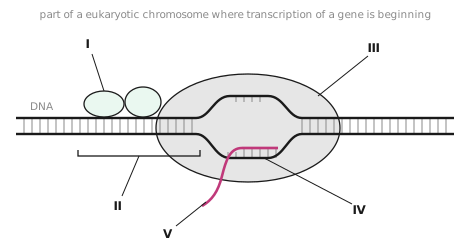
D1.2 examPart of a eukaryotic chromosome at the momentHL
12345
1
2
3
4
5
D1.2.1, D1.2.2Transcription
1234
1
2
3
4
The enzyme separates the two DNA strands by breaking the between their bases. Each incoming base pairs with an exposed base on one strand, adenine in the DNA with in the RNA, and the enzyme links them into a chain to that strand.
D1.2Protein synthesis
D1.2.2, D1.2.7, D1.2.8Codons and anticodons
Amino acid
DNA template
mRNA codon
tRNA anticodon
Methionine
TAC
Phenylalanine
UUU
Glycine
CCG
Histidine
GTA
Read in threes, four bases give codons, more than enough for 20 amino acids. Almost all organisms use the same codons: the genetic code is .
D1.2.12, D1.2.13, D1.2.14Non-coding DNAHL
Sequence
What it does
Promoter
Where bind, so that RNA polymerase can attach and begin transcription
Introns
Transcribed, then before the mRNA leaves the nucleus
Telomeres
Repeated sequences that the ends of chromosomes
Genes for tRNA and rRNA
Transcribed into RNA that is used without being
Transcription runs in the direction: each new nucleotide joins the growing end of the RNA.
D1.2.3, D1.2.4A stable template
A DNA strand can be transcribed again and again without any change to its base sequence. In cells that will never again, such as most nerve cells, that sequence must be for the whole life of the cell. Only some of a cell's genes are at any one time. Transcription is the stage of gene expression, so it is a key point at which genes are switched on and off.
D1.2.15, D1.2.16Processing the transcriptHL
1234
1
2
3
4
In cells the first RNA copy of a gene is modified before it is translated. The structures added at its two ends the mRNA. The bottom mRNA joins the coding sections in another combination, , so one gene can code for more than one .
D1.2.17Starting translationHL
Number the steps in order.
The large subunit attaches, completing the ribosome.
A second tRNA binds to the next codon and a peptide bond forms.
The small subunit of the ribosome binds to the 5′ end of the mRNA.
The initiator tRNA, carrying methionine, pairs with the start codon.
It moves along the mRNA to the start codon, AUG.
As the chain grows, a tRNA bringing a new amino acid enters the site, the tRNA holding the chain sits in the site, and the empty tRNA leaves from the site.
D1.2.18, D1.2.19Making insulin workHL
Many polypeptides must be modified before they can work. Insulin is made as pre-proinsulin: cutting off the gives proinsulin, and cutting out a middle section, the , leaves two chains held together by . Cells also break down proteins all the time in and reuse their , keeping the proteome working.
Word bank5′ cap5′ to 3′64AAAAAlaalternative splicingamino acidsanticodonAspAUGC-peptidecapillariesCAUCCGcomplementaryconserveddegeneratedisulfide bondsdivideEeukaryoticexonexpressedfirstGGCGlyGUAGUGhydrogen bondsintronlarge subunitmRNAPpeptidepoint mutationpoly-A tailpolypeptidepromoterproteasomesprotectremovedRNARNA nucleotideRNA polymerasesignal peptidesmall subunitstabilizetemplate strandthreetranscription factortranscription factorstranslatedtRNAUACuniversaluracilValvaline
Answer key
Every box on the sheet with its gaps filled in, as the subtopic reads in full.
LabelTranscription
RNA polymerase
template strand
mRNA
RNA nucleotide
The enzyme separates the two DNA strands by breaking the hydrogen bonds between their bases. Each incoming base pairs with an exposed base on one strand, adenine in the DNA with uracil in the RNA, and the enzyme links them into a chain complementary to that strand.
GapsA stable template
A DNA strand can be transcribed again and again without any change to its base sequence. In cells that will never divide again, such as most nerve cells, that sequence must be conserved for the whole life of the cell. Only some of a cell's genes are expressed at any one time. Transcription is the first stage of gene expression, so it is a key point at which genes are switched on and off.
LabelThe ribosome at work
large subunit
small subunit
mRNA
tRNA
polypeptide
Each amino acid is brought by a carrier molecule whose anticodon pairs with a codon. The ribosome joins each new amino acid to the chain with a peptide bond, then moves on by three bases, so the chain grows one amino acid at a time.
TableCodons and anticodons
Amino acid
DNA template
mRNA codon
tRNA anticodon
Methionine
TAC
AUG
UAC
Phenylalanine
AAA
UUU
AAA
Glycine
CCG
GGC
CCG
Histidine
GTA
CAU
GUA
Read in threes, four bases give 64 codons, more than enough for 20 amino acids. Almost all organisms use the same codons: the genetic code is universal.
GapsUsing a codon table
This is part of a table of mRNA codons, the ones that start with G. The mRNA GGU GCA GAU GUG codes for Gly, Ala, Asp and Val. Four different codons code for alanine: the code is degenerate.
GapsOne base, one amino acid
In sickle cell disease, a point mutation in the gene for the β chain of haemoglobin changes the mRNA codon GAG to GUG. The sixth amino acid becomes valine instead of glutamic acid. At low oxygen the altered molecules stick together and distort red blood cells, which can then block capillaries.
TableNon-coding DNA HL
Sequence
What it does
Promoter
Where transcription factors bind, so that RNA polymerase can attach and begin transcription
Introns
Transcribed, then removed before the mRNA leaves the nucleus
Telomeres
Repeated sequences that protect the ends of chromosomes
Genes for tRNA and rRNA
Transcribed into RNA that is used without being translated
Transcription runs in the 5′ to 3′ direction: each new nucleotide joins the growing end of the RNA.
LabelProcessing the transcript HL
intron
exon
5′ cap
poly-A tail
In eukaryotic cells the first RNA copy of a gene is modified before it is translated. The structures added at its two ends stabilize the mRNA. The bottom mRNA joins the coding sections in another combination, alternative splicing, so one gene can code for more than one polypeptide.
OrderStarting translation HL
The small subunit of the ribosome binds to the 5′ end of the mRNA.
It moves along the mRNA to the start codon, AUG.
The initiator tRNA, carrying methionine, pairs with the start codon.
The large subunit attaches, completing the ribosome.
A second tRNA binds to the next codon and a peptide bond forms.
As the chain grows, a tRNA bringing a new amino acid enters the A site, the tRNA holding the chain sits in the P site, and the empty tRNA leaves from the E site.
GapsMaking insulin work HL
Many polypeptides must be modified before they can work. Insulin is made as pre-proinsulin: cutting off the signal peptide gives proinsulin, and cutting out a middle section, the C-peptide, leaves two chains held together by disulfide bonds. Cells also break down proteins all the time in proteasomes and reuse their amino acids, keeping the proteome working.
Exam diagramPart of a eukaryotic chromosome at the moment HL
 Biology by Bradford
 12345
12345