The subtopic in the middle and ten tasks round it: label three diagrams, complete a table, put a process in order and fill 44 gaps. Every standard level statement has a box; the four boxes for higher level only are dashed and badged HL, and drop off for an SL class. Type into the blanks and check them, or print it on A4, Letter or A3 with an answer key.
Paper
Each subtopic on a landscape page, as shuffled and chosen on screen.
D1.3
Mutation and gene editing
Molecules · Continuity and change
Hover over a box to see it. Untick it to leave it off this sheet and its printout.
Name
D1.3.3Insertions and deletions
Adding or removing one base shifts the . Take the first C out of THE FAT CAT ATE THE RAT and it reads THE FAT ATA TET HER AT: every codon after the change is different, and a often turns up early. The polypeptide then rarely works, and large insertions or deletions have the same effect. Adding or removing exactly bases, though, leaves the codons after it unchanged.
D1.3.9Editing with CRISPRHL
Number the steps in order.
Cas9 cuts both strands of the DNA at that point.
Deliver the guide RNA and Cas9 into the cells to be edited.
Combine the guide RNA with the enzyme Cas9.
The cell repairs the cut, disabling the gene or inserting a supplied sequence.
Design a guide RNA whose bases are complementary to the target sequence.
The guide RNA pairs with the matching sequence in the cell's DNA.
In 2023 a CRISPR treatment was approved for the first time, for . Editing cells or embryos raises ethical questions, as the change would pass to future generations. Rules differ from country to country, so there is an international effort to them.
D1.3.10Sequences that barely changeHL
The shaded block is identical in all four species, although yeast and humans last shared an ancestor over a billion years ago: it is . One hypothesis: the gene product's function is so important that almost any change is , so natural removes it. Another: the region has a slower .
D1.3.1Changing the sequence
123
1
2
3
The top row is the original. Each row below shows a gene mutation, a change in the gene's . Only one of the three alters a single and leaves the rest of the gene to be read as before.
D1.3Mutation and gene editing
D1.3.2Swapping one base
Change in mRNA
Amino acid
Effect on the polypeptide
GCU → GCC
alanine → alanine
AAA → AGA
lysine → arginine
amino acid is different
UGG → UGA
tryptophan →
translation ends early, so it is
Because the code is , a base substitution may not change the amino acid at all. A base that differs between individuals at one position in the genome is a .
D1.3.7Why mutation matters
Gene mutation is the original source of all genetic . Most mutations are harmful or , but a rare one is beneficial, and natural can spread it, so in the long term mutation is essential for . A commercial genetic test may reveal a risk of future disease, but without expert its results can mislead.
D1.3.4, D1.3.5Causes and chance
Some gene mutations are errors made when DNA is or repaired. Others are caused by : high-energy radiation such as light, X-rays and gamma rays, and chemicals such as benzene, mustard gas and those in tobacco smoke. Mutation is : it can happen anywhere in the genome, though some bases mutate more often than others, and no natural mechanism changes a chosen base to produce a trait.
D1.3.6Where it happens
1234
1
2
3
4
In an animal, a mutation in a cell is not passed to offspring, though it may make cells divide out of control. A mutation in a germ cell can be , and is then present in cell of the offspring.
D1.3.8What does this gene do?HL
One way to find a gene's function is to change it so that it is , then see how the organism differs from normal ones. An organism changed in this way is a organism, and libraries of them are kept for species used as , such as the mouse.
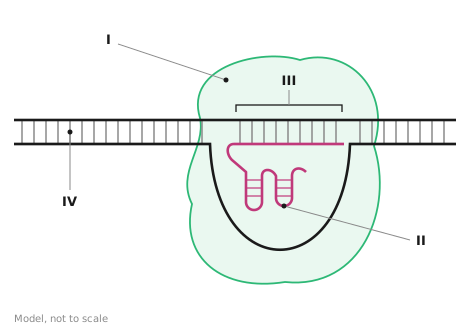
D1.3 examA model of the complex used in one gene-editing technologyHL
Every box on the sheet with its gaps filled in, as the subtopic reads in full.
LabelChanging the sequence
substitution
insertion
deletion
The top row is the original. Each row below shows a gene mutation, a change in the gene's base sequence. Only one of the three alters a single codon and leaves the rest of the gene to be read as before.
TableSwapping one base
Change in mRNA
Amino acid
Effect on the polypeptide
GCU → GCC
alanine → alanine
none
AAA → AGA
lysine → arginine
one amino acid is different
UGG → UGA
tryptophan → stop
translation ends early, so it is shorter
Because the code is degenerate, a base substitution may not change the amino acid at all. A base that differs between individuals at one position in the genome is a single-nucleotide polymorphism.
GapsInsertions and deletions
Adding or removing one base shifts the reading frame. Take the first C out of THE FAT CAT ATE THE RAT and it reads THE FAT ATA TET HER AT: every codon after the change is different, and a stop codon often turns up early. The polypeptide then rarely works, and large insertions or deletions have the same effect. Adding or removing exactly three bases, though, leaves the codons after it unchanged.
GapsCauses and chance
Some gene mutations are errors made when DNA is replicated or repaired. Others are caused by mutagens: high-energy radiation such as ultraviolet light, X-rays and gamma rays, and chemicals such as benzene, mustard gas and those in tobacco smoke. Mutation is random: it can happen anywhere in the genome, though some bases mutate more often than others, and no natural mechanism changes a chosen base to produce a trait.
LabelWhere it happens
tumour
sperm
egg
embryo
In an animal, a mutation in a somatic cell is not passed to offspring, though it may make cells divide out of control. A mutation in a germ cell can be inherited, and is then present in every cell of the offspring.
GapsWhy mutation matters
Gene mutation is the original source of all genetic variation. Most mutations are harmful or neutral, but a rare one is beneficial, and natural selection can spread it, so in the long term mutation is essential for evolution. A commercial genetic test may reveal a risk of future disease, but without expert interpretation its results can mislead.
GapsWhat does this gene do? HL
One way to find a gene's function is to change it so that it is inoperative, then see how the organism differs from normal ones. An organism changed in this way is a knockout organism, and libraries of them are kept for species used as models, such as the mouse.
OrderEditing with CRISPR HL
Design a guide RNA whose bases are complementary to the target sequence.
Combine the guide RNA with the enzyme Cas9.
Deliver the guide RNA and Cas9 into the cells to be edited.
The guide RNA pairs with the matching sequence in the cell's DNA.
Cas9 cuts both strands of the DNA at that point.
The cell repairs the cut, disabling the gene or inserting a supplied sequence.
In 2023 a CRISPR treatment was approved for the first time, for sickle cell disease. Editing germ cells or embryos raises ethical questions, as the change would pass to future generations. Rules differ from country to country, so there is an international effort to harmonize them.
GapsSequences that barely change HL
The shaded block is identical in all four species, although yeast and humans last shared an ancestor over a billion years ago: it is highly conserved. One hypothesis: the gene product's function is so important that almost any change is harmful, so natural selection removes it. Another: the region has a slower mutation rate.
Exam diagramA model of the complex used in one gene-editing technology HL
 Biology by Bradford
 1234
1234