D1.1.1Why copy DNA?
DNA replication makes two DNA molecules whose base sequences are . All organisms need it to ; multicellular organisms also need it for and for tissue .
 Biology by Bradford
support
Biology by Bradford
support
The subtopic in the middle and ten tasks round it: label five diagrams, complete two tables, put a process in order and fill 50 gaps. Every standard level statement has a box; the four boxes for higher level only are dashed and badged HL, and drop off for an SL class. Type into the blanks and check them, or print it on A4, Letter or A3 with an answer key.
DNA replication makes two DNA molecules whose base sequences are . All organisms need it to ; multicellular organisms also need it for and for tissue .
One enzyme unwinds the helix and separates the two strands by breaking the between their bases. The other builds a new strand along each separated one, adding units that pair with the exposed bases: adenine with , cytosine with .
Number the steps in order.
Profiles are compared in paternity tests and in investigations. Comparing more markers makes a false match , so the test is more .
| Enzyme | What it does |
|---|---|
| DNA primase | Makes the short stretch of that each new strand starts from |
| DNA polymerase III | Adds DNA nucleotides one by one, building the new strand in the direction |
| DNA polymerase I | Removes the and fills each gap with DNA |
| DNA ligase | Joins the by sealing gaps in the sugar-phosphate backbone |
| Step | Temperature | What happens |
|---|---|---|
| Denaturation | about °C | Hydrogen bonds break and the two strands separate |
| Annealing | about 55 °C | bind to each strand at the ends of the target sequence |
| Extension | about 72 °C | builds a new strand on each template |
The polymerase comes from a bacterium of hot springs, so it is . Each cycle the amount of the target sequence.
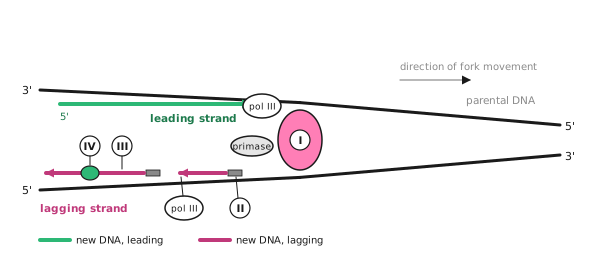
DNA polymerase can only add nucleotides to the end of a strand. So one new strand is built , towards the fork, while the other is built , away from the fork, and has to be started again and again.
 1234
1234This way of copying DNA is called replication. Each base can pair with only one other, so every new strand is to the strand it was built on, and copies are very .
DNA's groups carry a negative charge, so it moves through the gel towards the electrode, and the fragments separate by . Lane M is a mother, C her child, and A and B two men. Every band of the child's matches one of the mother's or one of the father's, so the father is man .
DNA polymerase III checks each nucleotide it adds. If the one at the end of the new strand carries a base, the enzyme it and adds a correctly paired nucleotide instead. This keeps copying errors very rare.
DNA replication makes two DNA molecules whose base sequences are identical. All organisms need it to reproduce; multicellular organisms also need it for growth and for tissue replacement.
This way of copying DNA is called semi-conservative replication. Each base can pair with only one other, so every new strand is complementary to the strand it was built on, and copies are very accurate.
One enzyme unwinds the helix and separates the two strands by breaking the hydrogen bonds between their bases. The other builds a new strand along each separated one, adding units that pair with the exposed bases: adenine with thymine, cytosine with guanine.
| Step | Temperature | What happens |
|---|---|---|
| Denaturation | about 95 °C | Hydrogen bonds break and the two strands separate |
| Annealing | about 55 °C | Primers bind to each strand at the ends of the target sequence |
| Extension | about 72 °C | Taq polymerase builds a new strand on each template |
The polymerase comes from a bacterium of hot springs, so it is heat-stable. Each cycle doubles the amount of the target sequence.
DNA's phosphate groups carry a negative charge, so it moves through the gel towards the positive electrode, and the fragments separate by size. Lane M is a mother, C her child, and A and B two men. Every band of the child's matches one of the mother's or one of the father's, so the father is man B.
Profiles are compared in paternity tests and in forensic investigations. Comparing more markers makes a false match less likely, so the test is more reliable.
DNA polymerase can only add nucleotides to the 3′ end of a strand. So one new strand is built continuously, towards the fork, while the other is built discontinuously, away from the fork, and has to be started again and again.
| Enzyme | What it does |
|---|---|
| DNA primase | Makes the short stretch of RNA that each new strand starts from |
| DNA polymerase III | Adds DNA nucleotides one by one, building the new strand in the 5′ to 3′ direction |
| DNA polymerase I | Removes the primers and fills each gap with DNA |
| DNA ligase | Joins the Okazaki fragments by sealing gaps in the sugar-phosphate backbone |
DNA polymerase III checks each nucleotide it adds. If the one at the 3′ end of the new strand carries a mismatched base, the enzyme removes it and adds a correctly paired nucleotide instead. This proofreading keeps copying errors very rare.