The subtopic in the middle and nine tasks round it: label three diagrams, complete a table, put a process in order and fill 42 gaps. The whole subtopic is higher level. Type into the blanks and check them, or print it on A4, Letter or A3 with an answer key.
Paper
Each subtopic on a landscape page, as shuffled and chosen on screen.
D2.2
Gene expression
Cells · Continuity and change
Hover over a box to see it. Untick it to leave it off this sheet and its printout.
Name
D2.2.2Switching a gene onHL
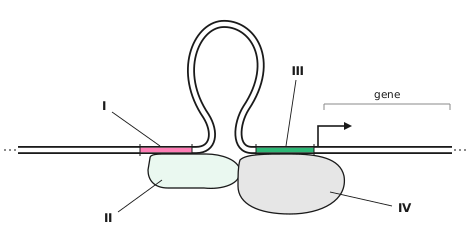
Proteins that bind to specific base sequences in DNA and control its transcription are . Some bind at the , just before the gene, where they help attach. Others bind at an , which can be thousands of bases away, and raise the rate at which the gene is transcribed.
D2.2.6Two kinds of tagHL
1234
1
2
3
4
On DNA, these tags are added to the base . In a promoter they transcription of the gene downstream. On histones they may do the same or the reverse, it. Neither kind changes the .
D2.2.11Signals from outsideHL
Lactose, in E. coli
Oestradiol, a hormone
Binds to
a
a
Then
the protein lets go of the DNA
the pair binds to the DNA
Target genes
Result
enzymes made to lactose
e.g. uterus lining thickens
D2.2.1From gene to traitHL
Number the steps in order.
The polypeptide folds into a protein, such as an enzyme.
RNA polymerase makes an mRNA copy of the gene's base sequence.
The enzyme catalyses a reaction whose product shapes the phenotype, such as a flower's colour.
The mRNA moves out of the nucleus to a ribosome.
The ribosome reads the codons and links amino acids into a polypeptide.
Copying the gene into mRNA is ; building the polypeptide is .
D2.2Gene expression
D2.2.7, D2.2.9Inherited tagsHL
Tags that stay in place through are passed to daughter cells; tags that survive can reach offspring, changing their phenotype with no change to the DNA. Most tags are from sperm and egg, but not all. So a , from a lion father and a tiger mother, grows far bigger than either parent, while a , from a tiger father and a lion mother, does not.
D2.2.8, D2.2.10Identical twinsHL
Monozygotic twins develop from one , so their are identical and any difference between them comes from the . The older the twins, the more their tag patterns differ, as the graph shows. Air pollution is one factor known to change the tags on DNA.
D2.2.3How long mRNA lastsHL
Enzymes called break mRNA down. In human cells one mRNA may last a few minutes or several . The longer it lasts, the more often it is , so controlling its breakdown controls how much is made.
D2.2.4, D2.2.5A cell's three setsHL
123
1
2
3
No cell expresses all of its genes, and the pattern it does express decides how it . Setting up these patterns as an organism develops is : the phenotype of the cells changes, but not their .
D2.2 examA length of DNA near a eukaryotic geneHL
1234
1
2
3
4
Word bankactivatebase sequencecytosinedaysdifferentiatesdigestenhancerenvironmentepigenesisgenomegenomesgenotypehistoneligermeiosismethylmethyl groupmitosisnucleasespromoterproteinproteomereceptorremovedrepressrepressorRNA polymeraseswitched ontigontranscriptiontranscription factortranscription factorstranscriptometranslatedtranslationzygote
Answer key
Every box on the sheet with its gaps filled in, as the subtopic reads in full.
OrderFrom gene to trait HL
RNA polymerase makes an mRNA copy of the gene's base sequence.
The mRNA moves out of the nucleus to a ribosome.
The ribosome reads the codons and links amino acids into a polypeptide.
The polypeptide folds into a protein, such as an enzyme.
The enzyme catalyses a reaction whose product shapes the phenotype, such as a flower's colour.
Copying the gene into mRNA is transcription; building the polypeptide is translation.
GapsSwitching a gene on HL
Proteins that bind to specific base sequences in DNA and control its transcription are transcription factors. Some bind at the promoter, just before the gene, where they help RNA polymerase attach. Others bind at an enhancer, which can be thousands of bases away, and raise the rate at which the gene is transcribed.
GapsHow long mRNA lasts HL
Enzymes called nucleases break mRNA down. In human cells one mRNA may last a few minutes or several days. The longer it lasts, the more often it is translated, so controlling its breakdown controls how much protein is made.
LabelA cell's three sets HL
genome
transcriptome
proteome
No cell expresses all of its genes, and the pattern it does express decides how it differentiates. Setting up these patterns as an organism develops is epigenesis: the phenotype of the cells changes, but not their genotype.
LabelTwo kinds of tag HL
histone
methyl group
methyl group
promoter
On DNA, these tags are added to the base cytosine. In a promoter they repress transcription of the gene downstream. On histones they may do the same or the reverse, activate it. Neither kind changes the base sequence.
GapsInherited tags HL
Tags that stay in place through mitosis are passed to daughter cells; tags that survive meiosis can reach offspring, changing their phenotype with no change to the DNA. Most tags are removed from sperm and egg, but not all. So a liger, from a lion father and a tiger mother, grows far bigger than either parent, while a tigon, from a tiger father and a lion mother, does not.
GapsIdentical twins HL
Monozygotic twins develop from one zygote, so their genomes are identical and any difference between them comes from the environment. The older the twins, the more their tag patterns differ, as the graph shows. Air pollution is one factor known to change the methyl tags on DNA.
TableSignals from outside HL
Lactose, in E. coli
Oestradiol, a hormone
Binds to
a repressor
a receptor
Then
the protein lets go of the DNA
the pair binds to the DNA
Target genes
switched on
switched on
Result
enzymes made to digest lactose
e.g. uterus lining thickens
Exam diagramA length of DNA near a eukaryotic gene HL
 Biology by Bradford
 1234
1234