The subtopic in the middle and eleven tasks round it: label four diagrams, complete two tables, put a process in order and fill 52 gaps. Every standard level statement has a box; the three boxes for higher level only are dashed and badged HL, and drop off for an SL class. Type into the blanks and check them, or print it on A4, Letter or A3 with an answer key.
Paper
Each subtopic on a landscape page, as shuffled and chosen on screen.
D2.3
Water potential
Cells · Continuity and change
Hover over a box to see it. Untick it to leave it off this sheet and its printout.
Name
D2.3.6A plant cell losing water
1234
1
2
3
4
Water entering from a hypotonic solution swells the cell's contents until they press outwards with , and the cell is . Water leaving into a hypertonic solution shrinks them away from the edge of the cell: .
D2.3.4Reading the results
Cylinders in the weakest solutions mass: those solutions were hypotonic to the tissue. Where the curve crosses zero, the solution is with the tissue, here at about mol dm⁻³. The error bars show the ; where the bars of two means overlap, their difference may not be .
D2.3.8, D2.3.9What Ψ measuresHL
Water potential, Ψ, is the of water per unit volume. It cannot be measured absolutely, so pure water at atmospheric pressure and 20 °C is given the value , and values are usually in . Water moves from to lower water potential, losing energy as it goes, like a ball rolling downhill.
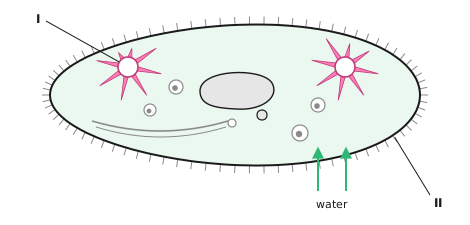
D2.3 examParamecium, a unicellular organism that lives in fresh water
12
1
2
D2.3.1Dissolving in water
123
1
2
3
Water molecules are : the oxygen is slightly negative and each hydrogen slightly positive. Surrounding solute particles with water molecules like this is , and it is why ions and polar molecules are .
D2.3.5, D2.3.7Matching concentrations
A multicellular animal keeps its tissue fluid with its cells, so they neither swell nor shrink. Medicine does the same. A drip into a vein is 0.9% sodium chloride, , with the same solute concentration as blood . A kidney or heart awaiting is kept cold in a solution that matches its cells, so they keep their shape.
D2.3Water potential
D2.3.10Adding up ΨHL
Ψs / kPa
Ψp / kPa
Ψ / kPa
Turgid cell
−700
+300
Cell at full turgor in pure water
−500
0
Plasmolysed cell
0
−900
Xylem sap under tension
−100
−600
Ψ = Ψs + Ψp. Solute potential is zero or ; pressure potential is usually inside cells, but not in xylem sap pulled up under tension.
D2.3.11Tissue in two solutionsHL
A potato cell has Ψs = −600 kPa. In pure water, which is hypotonic, water enters until Ψp has risen to about kPa, making the cell's Ψ equal to that of the water. In a hypertonic solution of −1000 kPa, water leaves, Ψp falls to , and the cell becomes . Water keeps leaving until Ψs inside has fallen to kPa.
D2.3.2, D2.3.3Which way does water move?
Solution outside the cell
Its solute concentration, compared with the cell's
Net movement of water
Hypotonic
into the cell
Isotonic
Hypertonic
higher
Water moves by from the less concentrated solution to the concentrated one. In an isotonic solution it still crosses the membrane, as fast in as out: a .
D2.3.5Red cells in three solutions
123
1
2
3
With no wall to hold it, an animal cell that gains too much water swells and may ; one that loses water shrinks, its surface puckering: . A freshwater protist such as Paramecium uses contractile vacuoles to pump out the water that keeps entering by .
D2.3.4Finding the isotonic point
Number the steps in order.
Put cylinders into each of a range of sucrose solutions, all at the same temperature.
Plot the mean percentage change against concentration and find where it is zero.
After the same time in each, take them out, blot them dry and weigh them again.
Cut potato cylinders of equal size, blot them dry and weigh each one.
Work out the percentage change in mass of each cylinder.
Repeats at each concentration give a mean and a , which shows how spread out the results are.
Word bank+500+600−1000−400−500−9000.3burstcell wallcontractile vacuolecrenationdynamic equilibriumequalexternal solutiongainedhigherhydrogen bondhydrophilichypertonichypotonicisotonickilopascalslowermorenegativenegative ionnoneosmosisout of the cellplasmaplasma membraneplasmolysedplasmolysispolarpositivepositive ionpotential energysalinesignificantsolvationstandard deviationstandard errortransplantturgidturgor pressurevacuolezero
Answer key
Every box on the sheet with its gaps filled in, as the subtopic reads in full.
LabelDissolving in water
positive ion
negative ion
hydrogen bond
Water molecules are polar: the oxygen is slightly negative and each hydrogen slightly positive. Surrounding solute particles with water molecules like this is solvation, and it is why ions and polar molecules are hydrophilic.
TableWhich way does water move?
Solution outside the cell
Its solute concentration, compared with the cell's
Net movement of water
Hypotonic
lower
into the cell
Isotonic
equal
none
Hypertonic
higher
out of the cell
Water moves by osmosis from the less concentrated solution to the more concentrated one. In an isotonic solution it still crosses the membrane, as fast in as out: a dynamic equilibrium.
LabelRed cells in three solutions
hypertonic
hypotonic
isotonic
With no wall to hold it, an animal cell that gains too much water swells and may burst; one that loses water shrinks, its surface puckering: crenation. A freshwater protist such as Paramecium uses contractile vacuoles to pump out the water that keeps entering by osmosis.
LabelA plant cell losing water
cell wall
plasma membrane
vacuole
external solution
Water entering from a hypotonic solution swells the cell's contents until they press outwards with turgor pressure, and the cell is turgid. Water leaving into a hypertonic solution shrinks them away from the edge of the cell: plasmolysis.
OrderFinding the isotonic point
Cut potato cylinders of equal size, blot them dry and weigh each one.
Put cylinders into each of a range of sucrose solutions, all at the same temperature.
After the same time in each, take them out, blot them dry and weigh them again.
Work out the percentage change in mass of each cylinder.
Plot the mean percentage change against concentration and find where it is zero.
Repeats at each concentration give a mean and a standard deviation, which shows how spread out the results are.
GapsReading the results
Cylinders in the weakest solutions gained mass: those solutions were hypotonic to the tissue. Where the curve crosses zero, the solution is isotonic with the tissue, here at about 0.3 mol dm⁻³. The error bars show the standard error; where the bars of two means overlap, their difference may not be significant.
GapsMatching concentrations
A multicellular animal keeps its tissue fluid isotonic with its cells, so they neither swell nor shrink. Medicine does the same. A drip into a vein is 0.9% sodium chloride, saline, with the same solute concentration as blood plasma. A kidney or heart awaiting transplant is kept cold in a solution that matches its cells, so they keep their shape.
GapsWhat Ψ measures HL
Water potential, Ψ, is the potential energy of water per unit volume. It cannot be measured absolutely, so pure water at atmospheric pressure and 20 °C is given the value zero, and values are usually in kilopascals. Water moves from higher to lower water potential, losing energy as it goes, like a ball rolling downhill.
TableAdding up Ψ HL
Ψs / kPa
Ψp / kPa
Ψ / kPa
Turgid cell
−700
+300
−400
Cell at full turgor in pure water
−500
+500
0
Plasmolysed cell
−900
0
−900
Xylem sap under tension
−100
−500
−600
Ψ = Ψs + Ψp. Solute potential is zero or negative; pressure potential is usually positive inside cells, but not in xylem sap pulled up under tension.
GapsTissue in two solutions HL
A potato cell has Ψs = −600 kPa. In pure water, which is hypotonic, water enters until Ψp has risen to about +600 kPa, making the cell's Ψ equal to that of the water. In a hypertonic solution of −1000 kPa, water leaves, Ψp falls to zero, and the cell becomes plasmolysed. Water keeps leaving until Ψs inside has fallen to −1000 kPa.
Exam diagramParamecium, a unicellular organism that lives in fresh water
 Biology by Bradford
 12
12