A1.2.1The genetic material
The genetic material of every living organism is . Some use RNA instead, but they are not counted as living organisms.
 Biology by Bradford
support
Biology by Bradford
support
The subtopic in the middle and eleven tasks round it: label five diagrams, complete three tables, put a process in order and fill 51 gaps. Every standard level statement has a box; the five boxes for higher level only are dashed and badged HL, and drop off for an SL class. Type into the blanks and check them, or print it on A4, Letter or A3 with an answer key.
The genetic material of every living organism is . Some use RNA instead, but they are not counted as living organisms.
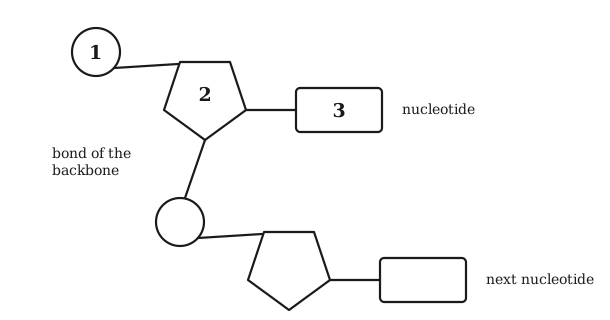
Nucleotides join by reactions into a chain, each linked to the next by bonds: a strong backbone with the bases sticking out from it. RNA is one such chain.
Number the steps in order.
So the genetic material is .
| Source | % A | % T | % G | % C |
|---|---|---|---|---|
| Human | 31 | 29 | 20 | 20 |
| Wheat | 27 | 27 | 23 | 23 |
| Yeast | 31 | 33 | 19 | 17 |
| E. coli | 25 | 24 | 26 | 26 |
In every species %A is close to % and %G close to %, so purines equal : evidence for complementary base pairing.
| DNA | RNA | |
|---|---|---|
| Pentose sugar | ||
| Bases | A, , C, G | A, , C, G |
| Number of strands | ||
| Shape | a single strand |
DNA wraps about twice round a core of histone proteins, packing it into the nucleus and helping control which genes are expressed.
 123
123The two strands run in opposite directions: they are . Adenine pairs with and cytosine with , held by hydrogen bonds.
Each base pairs with only one other, so either strand can act as a : complementary base pairing lets DNA be and its information . A stretch n bases long can be arranged in to the power n ways, so the storage capacity of DNA is almost limitless. Every living thing uses the same genetic code: evidence of .
New nucleotides are added to the end, so nucleic acids are built in the 5′ to 3′ direction.
| Base | Purine or pyrimidine? | Rings |
|---|---|---|
| Adenine | ||
| Guanine | ||
| Cytosine | ||
| Thymine |
A purine always pairs with a , so the helix keeps the same width all along.
The genetic material of every living organism is DNA. Some viruses use RNA instead, but they are not counted as living organisms.
Nucleotides join by condensation reactions into a chain, each linked to the next by covalent bonds: a strong sugar-phosphate backbone with the bases sticking out from it. RNA is one such chain.
| DNA | RNA | |
|---|---|---|
| Pentose sugar | deoxyribose | ribose |
| Bases | A, T, C, G | A, U, C, G |
| Number of strands | two | one |
| Shape | double helix | a single strand |
The two strands run in opposite directions: they are antiparallel. Adenine pairs with thymine and cytosine with guanine, held by hydrogen bonds.
Each base pairs with only one other, so either strand can act as a template: complementary base pairing lets DNA be replicated and its information expressed. A stretch n bases long can be arranged in 4 to the power n ways, so the storage capacity of DNA is almost limitless. Every living thing uses the same genetic code: evidence of universal common ancestry.
New nucleotides are added to the 3′ end, so nucleic acids are built in the 5′ to 3′ direction.
| Base | Purine or pyrimidine? | Rings |
|---|---|---|
| Adenine | purine | two |
| Guanine | purine | two |
| Cytosine | pyrimidine | one |
| Thymine | pyrimidine | one |
A purine always pairs with a pyrimidine, so the helix keeps the same width all along.
DNA wraps about twice round a core of eight histone proteins, packing it into the nucleus and helping control which genes are expressed.
So the genetic material is DNA.
| Source | % A | % T | % G | % C |
|---|---|---|---|---|
| Human | 31 | 29 | 20 | 20 |
| Wheat | 27 | 27 | 23 | 23 |
| Yeast | 31 | 33 | 19 | 17 |
| E. coli | 25 | 24 | 26 | 26 |
In every species %A is close to %T and %G close to %C, so purines equal pyrimidines: evidence for complementary base pairing.