The subtopic in the middle and nine tasks round it: label three diagrams, complete a table, put a process in order and fill 44 gaps. The whole subtopic is higher level. Type into the blanks and check them, or print it on A4, Letter or A3 with an answer key.
Paper
Each subtopic on a landscape page, as shuffled and chosen on screen.
A2.1
Origins of cells
Cells · Unity and diversity
Hover over a box to see it. Untick it to leave it off this sheet and its printout.
Name
A2.1.4Miller and Urey's apparatusHL
12345
1
2
3
4
5
After a week the water held : carbon compounds that life needs can form from simple molecules with no living thing involved. But early Earth's atmosphere was probably different from what they put in the flask, and no formed.
A2.1.7The root of all lifeHL
All living things use the same , and many are shared by every major group of organisms. This is evidence that all life descends from one . Other early forms of life may have arisen too, but became through with it and its descendants.
A2.1.8, A2.1.9When and where?HL
Life has been evolving for an immense time: at least 3.5 billion years. Rocks are dated from the decay of , which dates the inside them. LUCA is dated with a , from the number of base differences between the genes of living groups. Some of the oldest signs of life lie in rock that formed round on the ancient sea floor, and the genes conserved since LUCA suit life in hot water with no .
A2.1.1Early Earth and todayHL
Early Earth
Earth today
Free oxygen in the air
about 21%
Ozone layer
none
absorbs the most harmful
Greenhouse gases
more carbon dioxide and
less of both
Temperature
lower
In these conditions, carbon compounds may have formed by chemical processes that no longer happen.
A2.1.2Alive or not?HL
A cell is the smallest unit of self-sustaining life: on its own it carries out all the functions of life, from nutrition and growth to response and reproduction. Viruses are usually counted as : they have no , carry out no of their own, and can reproduce only inside a .
A2.1Origins of cells
A2.1.5A self-made compartmentHL
123
1
2
3
In water, molecules like these gather of their own accord into spheres walled by a : . A closed compartment lets the chemistry inside become from the chemistry outside.
A2.1.3From chemicals to cellsHL
Number the steps in order.
Small molecules join into polymers, such as chains of RNA.
The protocell grows and splits in two, passing copies of its RNA to each half.
Simple carbon compounds, such as amino acids and sugars, form from inorganic molecules.
Some RNA chains catalyse reactions, including copying themselves: catalysis and self-replication.
Fatty acids self-assemble into a vesicle round this RNA, making a compartment.
Today cells arise only from existing cells, so the first ones must have formed another way. These hypotheses are hard to : early Earth cannot be recreated exactly, and protocells did not .
A2.1.6An RNA worldHL
RNA may have been the first genetic material. Its base sequence carries information that can be , and some RNA molecules reactions: these are . So RNA could have been both the genes and the enzymes of the earliest cells. One still works in every cell today: in the , RNA joins amino acids with .
A2.1 examA section through a mineral chimney at a hydrothermal ventHL
1234
1
2
3
4
Word bankamino acidsbilayerboiling watercatalyseCH₄, NH₃ and H₂competitioncondensercytoplasmdifferentelectrodesextinctfatty acidfossilisefossilsgenesgenetic codehigherhost cellhydrophilic headhydrophobic tailhydrothermal fluidhydrothermal ventsinorganiclast universal common ancestormetabolismmethanemineral wallmolecular clocknon-livingnoneocean wateroxygenpeptide bondspolymersporeradioactive isotopesreplicatedribosomeribozymesspontaneouslytesttrapultravioletvesicles
Answer key
Every box on the sheet with its gaps filled in, as the subtopic reads in full.
TableEarly Earth and today HL
Early Earth
Earth today
Free oxygen in the air
none
about 21%
Ozone layer
none
absorbs the most harmful ultraviolet
Greenhouse gases
more carbon dioxide and methane
less of both
Temperature
higher
lower
In these conditions, carbon compounds may have formed spontaneously by chemical processes that no longer happen.
GapsAlive or not? HL
A cell is the smallest unit of self-sustaining life: on its own it carries out all the functions of life, from nutrition and growth to response and reproduction. Viruses are usually counted as non-living: they have no cytoplasm, carry out no metabolism of their own, and can reproduce only inside a host cell.
OrderFrom chemicals to cells HL
Simple carbon compounds, such as amino acids and sugars, form from inorganic molecules.
Small molecules join into polymers, such as chains of RNA.
Some RNA chains catalyse reactions, including copying themselves: catalysis and self-replication.
Fatty acids self-assemble into a vesicle round this RNA, making a compartment.
The protocell grows and splits in two, passing copies of its RNA to each half.
Today cells arise only from existing cells, so the first ones must have formed another way. These hypotheses are hard to test: early Earth cannot be recreated exactly, and protocells did not fossilise.
LabelMiller and Urey's apparatus HL
boiling water
CH₄, NH₃ and H₂
electrodes
condenser
trap
After a week the water held amino acids: carbon compounds that life needs can form from simple inorganic molecules with no living thing involved. But early Earth's atmosphere was probably different from what they put in the flask, and no polymers formed.
LabelA self-made compartment HL
hydrophilic head
hydrophobic tail
fatty acid
In water, molecules like these gather of their own accord into spheres walled by a bilayer: vesicles. A closed compartment lets the chemistry inside become different from the chemistry outside.
GapsAn RNA world HL
RNA may have been the first genetic material. Its base sequence carries information that can be replicated, and some RNA molecules catalyse reactions: these are ribozymes. So RNA could have been both the genes and the enzymes of the earliest cells. One still works in every cell today: in the ribosome, RNA joins amino acids with peptide bonds.
GapsThe root of all life HL
All living things use the same genetic code, and many genes are shared by every major group of organisms. This is evidence that all life descends from one last universal common ancestor. Other early forms of life may have arisen too, but became extinct through competition with it and its descendants.
GapsWhen and where? HL
Life has been evolving for an immense time: at least 3.5 billion years. Rocks are dated from the decay of radioactive isotopes, which dates the fossils inside them. LUCA is dated with a molecular clock, from the number of base differences between the genes of living groups. Some of the oldest signs of life lie in rock that formed round hydrothermal vents on the ancient sea floor, and the genes conserved since LUCA suit life in hot water with no oxygen.
Exam diagramA section through a mineral chimney at a hydrothermal vent HL
 Biology by Bradford
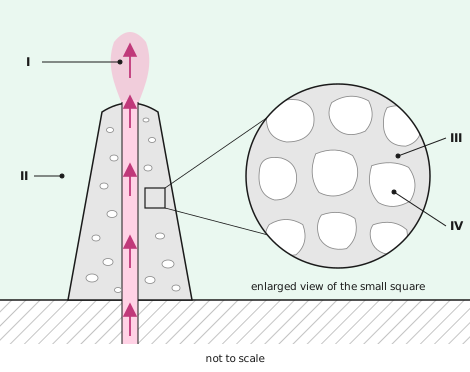 1234
1234