A2.3.2HIV up closeHL
12345
- 1
- 2
- 3
- 4
- 5
Its outer layer is a piece of the host cell's , taken as each new virus out of the cell.
 Biology by Bradford
support
Biology by Bradford
support
The subtopic in the middle and eight tasks round it: label three diagrams, complete a table, put a process in order and fill 40 gaps. The whole subtopic is higher level. Type into the blanks and check them, or print it on A4, Letter or A3 with an answer key.
Its outer layer is a piece of the host cell's , taken as each new virus out of the cell.
In the lysogenic cycle, lambda's DNA is into the bacterial chromosome, where it is called a . Most of its genes stay switched off, and it is copied with the host's DNA each time the cell , so every daughter cell inherits it. Stress such as can make it leave the chromosome and enter the .
All viruses are small and of a size, with no and few or no of their own.
Viruses are so varied that they probably arose , from different organisms: some may be cells that lost most of their parts, others genes that escaped from cells. What they share, such as a capsid and no metabolism, could be , shaped by the same extreme way of life: all viruses are parasites. They also use the same as living organisms, which fits an origin from cells.
Some viruses evolve very fast. They make huge numbers of copies, a new generation within hours or days, and the enzymes that copy the RNA genes of influenza and HIV do no , so their rate is very high. The surface proteins of influenza change so often that a new flu is made every year. HIV evolves inside each patient, so to any single drug soon appears: it is treated with a of antiretroviral drugs.
| Virus | Nucleic acid | Strands | Envelope? |
|---|---|---|---|
| Lambda phage | none | ||
| Coronavirus | yes | ||
| HIV | RNA | (two copies) |
Number the steps in order.
A virus has no metabolism of its own: it depends on its host for an supply, for raw materials and for .
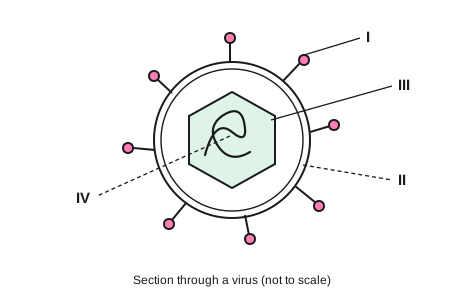 1234
1234All viruses are small and of a fixed size, with no cytoplasm and few or no enzymes of their own.
Its outer layer is a piece of the host cell's plasma membrane, taken as each new virus buds out of the cell.
| Virus | Nucleic acid | Strands | Envelope? |
|---|---|---|---|
| Lambda phage | DNA | double | none |
| Coronavirus | RNA | single | yes |
| HIV | RNA | single (two copies) | yes |
A virus has no metabolism of its own: it depends on its host for an energy supply, for raw materials and for protein synthesis.
In the lysogenic cycle, lambda's DNA is integrated into the bacterial chromosome, where it is called a prophage. Most of its genes stay switched off, and it is copied with the host's DNA each time the cell divides, so every daughter cell inherits it. Stress such as UV light can make it leave the chromosome and enter the lytic cycle.
Viruses are so varied that they probably arose several times, from different organisms: some may be cells that lost most of their parts, others genes that escaped from cells. What they share, such as a capsid and no metabolism, could be convergent evolution, shaped by the same extreme way of life: all viruses are obligate parasites. They also use the same genetic code as living organisms, which fits an origin from cells.
Some viruses evolve very fast. They make huge numbers of copies, a new generation within hours or days, and the enzymes that copy the RNA genes of influenza and HIV do no proofreading, so their mutation rate is very high. The surface proteins of influenza change so often that a new flu vaccine is made every year. HIV evolves inside each patient, so resistance to any single drug soon appears: it is treated with a combination of antiretroviral drugs.