B2.2.2One cell, two compartments
1234
- 1
- 2
- 3
- 4
In the prokaryote, translation can begin before has finished. In the eukaryote, translation waits until the message has moved out to the .
 Biology by Bradford
support
Biology by Bradford
support
The subtopic in the middle and nine tasks round it: label four diagrams, complete a table, put two processes in order and fill 40 gaps. Every standard level statement has a box; the four boxes for higher level only are dashed and badged HL, and drop off for an SL class. Type into the blanks and check them, or print it on A4, Letter or A3 with an answer key.
In the prokaryote, translation can begin before has finished. In the eukaryote, translation waits until the message has moved out to the .
Stacks of flattened membrane sacs give a large area for the that absorb light. The fluid inside each sac has a small , so protons pumped in build a steep gradient fast. The enzymes and substrates of the cycle are kept together in the fluid round the stacks.
Two membranes wrap the nucleus, keeping its DNA apart from the cytoplasm. So that mRNA can get out and proteins can get in, the double membrane is crossed by . At the start of mitosis and meiosis it breaks up into , letting the chromosomes be separated; afterwards these to rebuild a covering round each new nucleus.
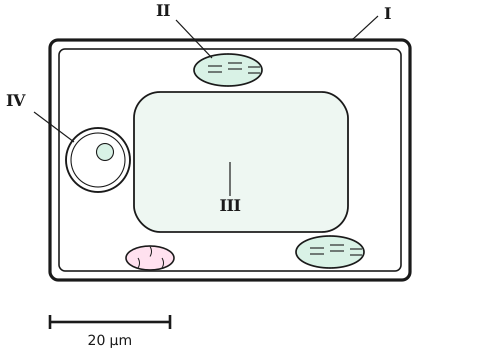
An organelle is a discrete subunit of a cell, adapted to its own job. Nuclei and vesicles count, and so do , although they have no membrane, and the round the cell. The cell wall does not, nor does the network of protein fibres called the , nor the that the organelles sit in.
Number the steps in order.
Proteins to be kept in the cytoplasm are made instead by ribosomes. Many vesicles bud with the help of , a protein that coats a patch of membrane and pulls it into a sphere.
 1234
1234Number the steps in order.
The first pellet is mostly . The highest speeds need an : its invention let biologists study one kind of organelle at a time, a case of progress in science following a new .
| Compartment | Holds | Benefit |
|---|---|---|
| Nucleus | DNA | transcripts before translation |
| Lysosome | enzymes | the rest of the cell is not digested |
| Phagocytic vacuole | a bacterium, with lysosome enzymes | enzymes and substrate at a high |
So compartments speed up reactions and keep processes separate.
The space between the two membranes is , so protons pumped into it quickly build a steep gradient. The folded inner membrane gives a large for the electron transport chain. The fluid inside keeps the enzymes and substrates of the cycle together.
An organelle is a discrete subunit of a cell, adapted to its own job. Nuclei and vesicles count, and so do ribosomes, although they have no membrane, and the plasma membrane round the cell. The cell wall does not, nor does the network of protein fibres called the cytoskeleton, nor the cytoplasm that the organelles sit in.
The first pellet is mostly nuclei. The highest speeds need an ultracentrifuge: its invention let biologists study one kind of organelle at a time, a case of progress in science following a new technique.
In the prokaryote, translation can begin before transcription has finished. In the eukaryote, translation waits until the message has moved out to the cytoplasm.
| Compartment | Holds | Benefit |
|---|---|---|
| Nucleus | DNA | transcripts modified before translation |
| Lysosome | digestive enzymes | the rest of the cell is not digested |
| Phagocytic vacuole | a bacterium, with lysosome enzymes | enzymes and substrate at a high concentration |
So compartments speed up reactions and keep incompatible processes separate.
The space between the two membranes is small, so protons pumped into it quickly build a steep gradient. The folded inner membrane gives a large surface area for the electron transport chain. The fluid inside keeps the enzymes and substrates of the Krebs cycle together.
Stacks of flattened membrane sacs give a large area for the photosystems that absorb light. The fluid inside each sac has a small volume, so protons pumped in build a steep gradient fast. The enzymes and substrates of the Calvin cycle are kept together in the fluid round the stacks.
Two membranes wrap the nucleus, keeping its DNA apart from the cytoplasm. So that mRNA can get out and proteins can get in, the double membrane is crossed by pores. At the start of mitosis and meiosis it breaks up into vesicles, letting the chromosomes be separated; afterwards these fuse to rebuild a covering round each new nucleus.
Proteins to be kept in the cytoplasm are made instead by free ribosomes. Many vesicles bud with the help of clathrin, a protein that coats a patch of membrane and pulls it into a sphere.