B2.3.5Cells of all sizes
12345
- 1
- 2
- 3
- 4
- 5
Many human cells are 10 to 30 µm across, but sizes vary widely with function. The biggest by volume is about mm across, the longest stretch about m, and striated muscle fibres can be several centimetres long.
 Biology by Bradford
support
Biology by Bradford
support
The subtopic in the middle and ten tasks round it: label four diagrams, complete three tables and fill 58 gaps. Every standard level statement has a box; the five boxes for higher level only are dashed and badged HL, and drop off for an SL class. Type into the blanks and check them, or print it on A4, Letter or A3 with an answer key.
Many human cells are 10 to 30 µm across, but sizes vary widely with function. The biggest by volume is about mm across, the longest stretch about m, and striated muscle fibres can be several centimetres long.
| Side / cm | Surface area / cm² | Volume / cm³ | SA:V |
|---|---|---|---|
| 1 | 6 | 1 | 6:1 |
| 2 | 8 | ||
| 3 | 54 | ||
| 4 | 1.5:1 |
As the cube grows, SA:V . Exchange happens across the surface but the need for it rises with volume, so cells stay or change shape. Cubes are a simple of a cell, but scale works on them the same way.
 1234
1234Red blood cells are discs, so no haemoglobin is far from the membrane. Cells lining the proximal convoluted tubule of the have on the side facing the filtrate and deep of the membrane on the side facing the blood, so they can reabsorb fast.
| Cardiac muscle cell | Striated muscle fibre | |
|---|---|---|
| Branching | ||
| Nuclei | ||
| Typical length | about 0.1 mm | up to several centimetres |
Both contain contractile . A striated muscle fibre forms when separate cells , so whether it counts as one cell is debated.
The flat cells are extremely , so gases have only a short distance to . The rounded cells discharge into the air space, stopping the alveoli sticking shut. One tissue needs two cell types because the job needs both adaptations.
Fertilisation makes a single cell, the , which divides into a ball of cells. Signal molecules spread out from one region, setting up concentration across the embryo. Each cell switches particular on or off according to the level it meets, so cells in different places follow different pathways and become specialised: .
Stem cells can divide again and again, , and their daughter cells can along different pathways. In adults they live in niches, such as the and the base of each . Signals in a niche either keep its stem cells as they are or make them and specialise.
| Stem cell | Can become | Example |
|---|---|---|
| any type of cell, including those of the placenta | cells of the embryo in its first few divisions | |
| any type of cell in the body, but not the placenta | cells of the embryo a few days later | |
| a few closely related types | stem cells in adult |
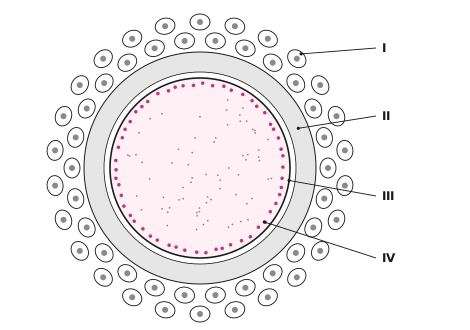
The cap at the front releases that digest a way through the layers round the egg. The egg cannot swim, but its large volume of stores nutrients for the early embryo. At fertilisation, release their contents, which harden the so that no second male gamete can get in.
Fertilisation makes a single cell, the zygote, which divides into a ball of unspecialised cells. Signal molecules spread out from one region, setting up concentration gradients across the embryo. Each cell switches particular genes on or off according to the level it meets, so cells in different places follow different pathways and become specialised: differentiation.
Stem cells can divide again and again, endlessly, and their daughter cells can differentiate along different pathways. In adults they live in niches, such as the bone marrow and the base of each hair follicle. Signals in a niche either keep its stem cells as they are or make them proliferate and specialise.
| Stem cell | Can become | Example |
|---|---|---|
| Totipotent | any type of cell, including those of the placenta | cells of the embryo in its first few divisions |
| Pluripotent | any type of cell in the body, but not the placenta | cells of the embryo a few days later |
| Multipotent | a few closely related types | stem cells in adult bone marrow |
Many human cells are 10 to 30 µm across, but sizes vary widely with function. The biggest by volume is about 0.1 mm across, the longest stretch about 1 m, and striated muscle fibres can be several centimetres long.
| Side / cm | Surface area / cm² | Volume / cm³ | SA:V |
|---|---|---|---|
| 1 | 6 | 1 | 6:1 |
| 2 | 24 | 8 | 3:1 |
| 3 | 54 | 27 | 2:1 |
| 4 | 96 | 64 | 1.5:1 |
As the cube grows, SA:V falls. Exchange happens across the surface but the need for it rises with volume, so cells stay small or change shape. Cubes are a simple model of a cell, but scale works on them the same way.
Red blood cells are flattened discs, so no haemoglobin is far from the membrane. Cells lining the proximal convoluted tubule of the nephron have microvilli on the side facing the filtrate and deep invaginations of the membrane on the side facing the blood, so they can reabsorb fast.
The flat cells are extremely thin, so gases have only a short distance to diffuse. The rounded cells discharge surfactant into the air space, stopping the alveoli sticking shut. One tissue needs two cell types because the job needs both adaptations.
| Cardiac muscle cell | Striated muscle fibre | |
|---|---|---|
| Branching | branched | unbranched |
| Nuclei | one | many |
| Typical length | about 0.1 mm | up to several centimetres |
Both contain contractile myofibrils. A striated muscle fibre forms when separate cells fuse, so whether it counts as one cell is debated.
The cap at the front releases enzymes that digest a way through the layers round the egg. The egg cannot swim, but its large volume of cytoplasm stores nutrients for the early embryo. At fertilisation, cortical granules release their contents, which harden the zona pellucida so that no second male gamete can get in.