B3.1.6Lung volumes
1234
- 1
- 2
- 3
- 4
A trace like this comes from a : the line rises as air is breathed in.
 Biology by Bradford
support
Biology by Bradford
support
The subtopic in the middle and twelve tasks round it: label six diagrams, complete a table, put a process in order and fill 58 gaps. Every standard level statement has a box; the two boxes for higher level only are dashed and badged HL, and drop off for an SL class. Type into the blanks and check them, or print it on A4, Letter or A3 with an answer key.
A trace like this comes from a : the line rises as air is breathed in.
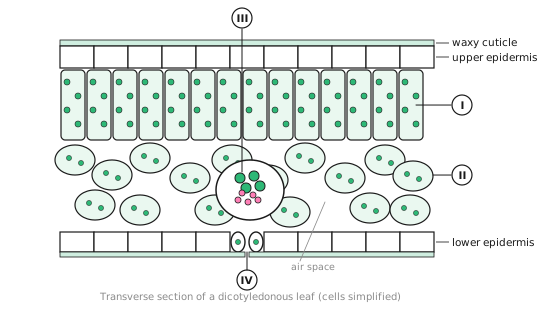
CO₂ diffuses in through the and spreads through the to the cells that photosynthesise. The upper is transparent, letting light through.
Stomatal density is the number of stomata per unit . Paint clear nail varnish on the lower surface, peel off the , and count the stomata in the field of view at high power: 30 in a field of 0.15 mm² is per mm². Counts vary from field to field, so take counts and use the .
 1234
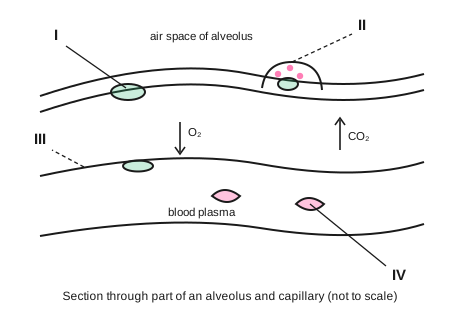
1234Diffusion stays fast only while the concentration gradient is steep. A dense network of and continuous carry absorbed O₂ away and keep bringing more CO₂. brings in fresh medium all the time: air to the lungs, over the gills.
A film of lines each tiny sac, lowering surface tension so its walls do not stick together and it does not when you breathe out. Hundreds of millions of sacs give the lungs a huge .
Number the steps in order.
Breathing out at rest is mostly passive, as these muscles relax. A forced breath out also uses the and the .
| If this rises | Transpiration rate | Because |
|---|---|---|
| Temperature | water evaporates and diffuses faster | |
| Humidity | the water vapour gradient from leaf to air is less steep | |
| Wind speed | humid air next to the leaf is blown away | |
| Light intensity | more open |
Transpiration is the loss of water vapour from leaves: the unavoidable cost of opening pores to take in for photosynthesis.
As an organism grows, its volume rises faster than its surface area, so its surface area-to-volume ratio : the 1 cm cube has a ratio of 6:1, the 3 cm cube only . Its centre also lies farther from the surface. So a large organism needs a gas-exchange surface that is permeable and large in area, so that gases can dissolve, and so that the diffusion distance is short.
Each curve is because oxygen binding is : once one O₂ binds, the protein changes shape and the next binds more easily.
Each haemoglobin molecule has four groups, each carrying one O₂. CO₂ binds at other, sites, changing the protein's shape so it holds O₂ less tightly. Actively respiring tissue makes more CO₂, so haemoglobin unloads more O₂ just where it is needed: the . Foetal haemoglobin has a affinity for O₂ than adult haemoglobin, so it takes O₂ from the mother's blood in the .
 1234
1234As an organism grows, its volume rises faster than its surface area, so its surface area-to-volume ratio falls: the 1 cm cube has a ratio of 6:1, the 3 cm cube only 2:1. Its centre also lies farther from the surface. So a large organism needs a gas-exchange surface that is permeable and large in area, moist so that gases can dissolve, and thin so that the diffusion distance is short.
Diffusion stays fast only while the concentration gradient is steep. A dense network of capillaries and continuous blood flow carry absorbed O₂ away and keep bringing more CO₂. Ventilation brings in fresh medium all the time: air to the lungs, water over the gills.
A film of surfactant lines each tiny sac, lowering surface tension so its walls do not stick together and it does not collapse when you breathe out. Hundreds of millions of sacs give the lungs a huge surface area.
Breathing out at rest is mostly passive, as these muscles relax. A forced breath out also uses the internal intercostal muscles and the abdominal muscles.
A trace like this comes from a spirometer: the line rises as air is breathed in.
CO₂ diffuses in through the stomata and spreads through the air spaces to the cells that photosynthesise. The upper epidermis is transparent, letting light through.
| If this rises | Transpiration rate | Because |
|---|---|---|
| Temperature | increases | water evaporates and diffuses faster |
| Humidity | decreases | the water vapour gradient from leaf to air is less steep |
| Wind speed | increases | humid air next to the leaf is blown away |
| Light intensity | increases | more stomata open |
Transpiration is the loss of water vapour from leaves: the unavoidable cost of opening pores to take in CO₂ for photosynthesis.
Stomatal density is the number of stomata per unit area. Paint clear nail varnish on the lower surface, peel off the cast, and count the stomata in the field of view at high power: 30 in a field of 0.15 mm² is 200 per mm². Counts vary from field to field, so take repeat counts and use the mean.
Each curve is S-shaped because oxygen binding is cooperative: once one O₂ binds, the protein changes shape and the next binds more easily.
Each haemoglobin molecule has four haem groups, each carrying one O₂. CO₂ binds at other, allosteric sites, changing the protein's shape so it holds O₂ less tightly. Actively respiring tissue makes more CO₂, so haemoglobin unloads more O₂ just where it is needed: the Bohr shift. Foetal haemoglobin has a higher affinity for O₂ than adult haemoglobin, so it takes O₂ from the mother's blood in the placenta.