The subtopic in the middle and twelve tasks round it: label five diagrams, complete two tables, put a process in order and fill 65 gaps. Every standard level statement has a box; the seven boxes for higher level only are dashed and badged HL, and drop off for an SL class. Type into the blanks and check them, or print it on A4, Letter or A3 with an answer key.
Paper
Each subtopic on a landscape page, as shuffled and chosen on screen.
C1.2
Cell respiration
Molecules · Interaction and interdependence
Hover over a box to see it. Untick it to leave it off this sheet and its printout.
Name
C1.2.2, C1.2.3Spending and recharging
of ATP to ADP and phosphate releases energy; joining ADP and phosphate back into ATP energy. The energy released powers across membranes, the synthesis of macromolecules, or , and movement, of whole cells or of parts such as .
C1.2.8Glycolysis step by stepHL
Number the steps in order.
Oxidation: hydrogen is removed from each 3C molecule and passed to NAD.
Lysis: the 6C sugar phosphate splits into two 3C sugar phosphates.
ATP formation: four ATP form as the two 3C molecules become pyruvate.
Phosphorylation: two ATP give phosphate groups to glucose, making it less stable.
Net yield per glucose: ATP and reduced NAD. Each step is catalysed by a different .
C1.2.9, C1.2.10Without oxygenHL
Glycolysis needs a supply of NAD. With no oxygen, pyruvate takes the hydrogen from reduced NAD and becomes , the NAD so glycolysis can continue, with a net yield of ATP per glucose. Yeast uses the same pathway, except that pyruvate becomes and CO₂. uses the first; baking uses the gas, which makes dough rise.
Reduced NAD from glycolysis, the link reaction and the Krebs cycle hands a pair of to the first carrier; the energy released as they pass along the chain pumps protons across the membrane. At the end of the chain they are taken up by , together with protons, forming . Protons flow back down their gradient through a channel enzyme that phosphorylates ADP: .
C1.2.7Carrying hydrogenHL
Oxidation is the loss of . Removing hydrogen, with its electron, from a substrate is called , so it oxidises the substrate. NAD accepts the hydrogen and is . Oxidation and reduction always happen together, in reactions.
C1.2.11, C1.2.12Into the cycleHL
1234
1
2
3
4
Removing CO₂ from a molecule is ; removing hydrogen is , a kind of oxidation. Each turn of the cycle includes oxidations, which reduce hydrogen carriers such as NAD, and makes one ATP.
C1.2Cell respiration
C1.2.17Lipid against carbohydrateHL
Lipid
Carbohydrate
Energy per gram
lower
Oxygen atoms per carbon
more
Respired without oxygen?
yes
Broken down first by
splitting fatty acids into 2C
, then the link reaction
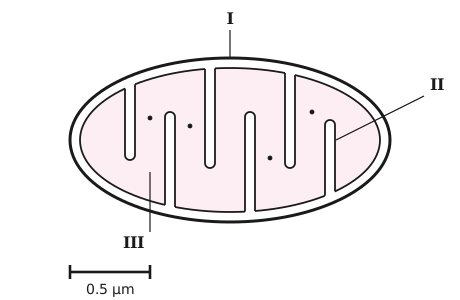
C1.2 examA mitochondrion as it appears in an electron micrographHL
123
1
2
3
C1.2.1Energy currency
123
1
2
3
ATP, adenosine , is a . It suits its job as the cell's energy currency: it is in water, so it moves easily round the cell, it is stable until an enzyme hydrolyses it, and each molecule releases a small, usable amount of energy.
C1.2.4Easily confused
Cell respiration releases energy from carbon compounds, step by step, to make . Glucose and are the main substrates, though many other organic compounds can be used, and it goes on in every living cell. Gas exchange is a different process: the of O₂ into the organism and CO₂ out across an exchange , such as the alveoli.
C1.2.5Two kinds of respiration
Aerobic
Anaerobic, in humans
Substrates
glucose, fatty acids and others
only
Mitochondria needed?
yes
ATP per glucose
about 30
Word equation
glucose + oxygen → +
glucose →
Both start in the .
C1.2.6A respirometer
12345
1
2
3
4
5
As the organisms respire, the CO₂ they give out is absorbed, so the oxygen they take in is not replaced and the gas volume . If the reading moves 18 mm in 6 minutes, the rate is mm min⁻¹. changes the rate, so the tube should stand in a water bath.
Every box on the sheet with its gaps filled in, as the subtopic reads in full.
LabelEnergy currency
adenine
ribose
phosphate
ATP, adenosine triphosphate, is a nucleotide. It suits its job as the cell's energy currency: it is soluble in water, so it moves easily round the cell, it is stable until an enzyme hydrolyses it, and each molecule releases a small, usable amount of energy.
GapsSpending and recharging
Hydrolysis of ATP to ADP and phosphate releases energy; joining ADP and phosphate back into ATP needs energy. The energy released powers active transport across membranes, the synthesis of macromolecules, or anabolism, and movement, of whole cells or of parts such as chromosomes.
GapsEasily confused
Cell respiration releases energy from carbon compounds, step by step, to make ATP. Glucose and fatty acids are the main substrates, though many other organic compounds can be used, and it goes on in every living cell. Gas exchange is a different process: the diffusion of O₂ into the organism and CO₂ out across an exchange surface, such as the alveoli.
TableTwo kinds of respiration
Aerobic
Anaerobic, in humans
Substrates
glucose, fatty acids and others
carbohydrate only
Mitochondria needed?
yes
no
ATP per glucose
about 30
2
Word equation
glucose + oxygen → CO₂ + water
glucose → lactate
Both start in the cytoplasm.
LabelA respirometer
organisms
gauze
soda lime
coloured liquid
capillary tube
As the organisms respire, the CO₂ they give out is absorbed, so the oxygen they take in is not replaced and the gas volume falls. If the reading moves 18 mm in 6 minutes, the rate is 3 mm min⁻¹. Temperature changes the rate, so the tube should stand in a water bath.
GapsCarrying hydrogen HL
Oxidation is the loss of electrons. Removing hydrogen, with its electron, from a substrate is called dehydrogenation, so it oxidises the substrate. NAD accepts the hydrogen and is reduced. Oxidation and reduction always happen together, in redox reactions.
OrderGlycolysis step by step HL
Phosphorylation: two ATP give phosphate groups to glucose, making it less stable.
Lysis: the 6C sugar phosphate splits into two 3C sugar phosphates.
Oxidation: hydrogen is removed from each 3C molecule and passed to NAD.
ATP formation: four ATP form as the two 3C molecules become pyruvate.
Net yield per glucose: two ATP and two reduced NAD. Each step is catalysed by a different enzyme.
GapsWithout oxygen HL
Glycolysis needs a supply of NAD. With no oxygen, pyruvate takes the hydrogen from reduced NAD and becomes lactate, regenerating the NAD so glycolysis can continue, with a net yield of two ATP per glucose. Yeast uses the same pathway, except that pyruvate becomes ethanol and CO₂. Brewing uses the first; baking uses the gas, which makes dough rise.
LabelInto the cycle HL
pyruvate
acetyl CoA
citrate
oxaloacetate
Removing CO₂ from a molecule is decarboxylation; removing hydrogen is dehydrogenation, a kind of oxidation. Each turn of the cycle includes four oxidations, which reduce hydrogen carriers such as NAD, and makes one ATP.
LabelThe inner membrane HL
intermembrane space
matrix
ATP synthase
electron carrier
Reduced NAD from glycolysis, the link reaction and the Krebs cycle hands a pair of electrons to the first carrier; the energy released as they pass along the chain pumps protons across the membrane. At the end of the chain they are taken up by oxygen, together with protons, forming water. Protons flow back down their gradient through a channel enzyme that phosphorylates ADP: chemiosmosis.
TableLipid against carbohydrate HL
Lipid
Carbohydrate
Energy per gram
higher
lower
Oxygen atoms per carbon
fewer
more
Respired without oxygen?
no
yes
Broken down first by
splitting fatty acids into 2C acetyl groups
glycolysis, then the link reaction
Exam diagramA mitochondrion as it appears in an electron micrograph HL
 Biology by Bradford
 123
123