C1.3.4Reading the strip
1234
- 1
- 2
- 3
- 4
Rf = distance moved by the pigment ÷ distance moved by the solvent, so the pigment that moved 36 mm here has an Rf of . Pigments are identified by their Rf values and their .
 Biology by Bradford
support
Biology by Bradford
support
The subtopic in the middle and twelve tasks round it: label six diagrams, complete a table, put a process in order and fill 63 gaps. Every standard level statement has a box; the six boxes for higher level only are dashed and badged HL, and drop off for an SL class. Type into the blanks and check them, or print it on A4, Letter or A3 with an answer key.
Rf = distance moved by the pigment ÷ distance moved by the solvent, so the pigment that moved 36 mm here has an Rf of . Pigments are identified by their Rf values and their .
An action spectrum shows the rate of at each wavelength; an absorption spectrum shows how much light a pigment absorbs. Here the action spectrum is the line. A pigment absorbs a photon only if its energy is just right to one of its electrons, so chlorophyll absorbs blue and red light but most green.
Photosystem II replaces the electrons it loses by splitting water: . The protons and electrons are used, but the oxygen is a . Its release changed Earth for ever: it oxidised iron dissolved in the oceans, which settled as banded rock, then built up in the air. Photosystem I passes two electrons to NADP, which also takes an H⁺ from the stroma and so is . In photophosphorylation, electrons from photosystem I return to the carrier chain instead, so only ATP is made.
The carbon-fixing enzyme is the most enzyme on Earth: it is slow and works poorly when CO₂ is low, so the stroma is packed with it. The 3C product of fixation is reduced using ATP and . Five 3C sugars are rearranged into 5C molecules, using more ATP, so to make glucose of the 3C sugar made is recycled.
Photosynthesis transforms light energy into energy in carbon compounds, the source of most of the energy that flows through ecosystems. In words: carbon dioxide + water → + oxygen. Splitting water supplies the needed to reduce the carbon dioxide, and the oxygen is given off as a . Plants, algae and all release oxygen this way.
Number the steps in order.
The origin line is drawn in , as ink would dissolve and run.
Here light intensity is the variable and the rate of photosynthesis is the variable. A hypothesis is a provisional explanation, so it needs testing.
| Enclosed greenhouse | Free-air CO₂ enrichment (FACE) | |
|---|---|---|
| Setting | a closed glasshouse or chamber | open |
| Control of other variables | harder, as weather and soil vary | |
| How realistic the results are |
Both predict how photosynthesis and plant growth will respond as atmospheric CO₂ . A variable kept the same in the enriched and control plots, such as the plant species, is a variable.
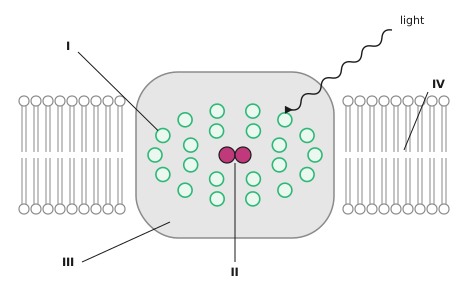
Energy from light absorbed anywhere in the array is passed inwards, pigment to pigment, until it an electron that is then emitted to an acceptor. A single pigment molecule could do no part of photosynthesis on its own: the array absorbs a wider range of and funnels the energy to one point.
Water is split on the side facing the , where pumped protons also build up, and NADP is reduced on the side facing the . Protons flow back down their gradient through a channel enzyme, making ATP by .
Every carbon atom in a plant's compounds was fixed in the : sugars, fatty acids and amino acids are made by pathways that start from its intermediates, and amino acids also need , taken up as a mineral nutrient. The two stages depend on each other. Without light, no ATP or reduced NADP is made, so GP is not converted to triose phosphate and runs out. Without CO₂, reduced NADP is not used, NADP runs out, electrons back up along the chain, and the stop.
 1234
1234Photosynthesis transforms light energy into chemical energy in carbon compounds, the source of most of the energy that flows through ecosystems. In words: carbon dioxide + water → glucose + oxygen. Splitting water supplies the hydrogen needed to reduce the carbon dioxide, and the oxygen is given off as a by-product. Plants, algae and cyanobacteria all release oxygen this way.
The origin line is drawn in pencil, as ink would dissolve and run.
Rf = distance moved by the pigment ÷ distance moved by the solvent, so the pigment that moved 36 mm here has an Rf of 0.45. Pigments are identified by their Rf values and their colour.
An action spectrum shows the rate of photosynthesis at each wavelength; an absorption spectrum shows how much light a pigment absorbs. Here the action spectrum is the dashed line. A pigment absorbs a photon only if its energy is just right to excite one of its electrons, so chlorophyll absorbs blue and red light but reflects most green.
Here light intensity is the independent variable and the rate of photosynthesis is the dependent variable. A hypothesis is a provisional explanation, so it needs repeated testing.
| Enclosed greenhouse | Free-air CO₂ enrichment (FACE) | |
|---|---|---|
| Setting | a closed glasshouse or chamber | open fields |
| Control of other variables | easier | harder, as weather and soil vary |
| How realistic the results are | less | more |
Both predict how photosynthesis and plant growth will respond as atmospheric CO₂ rises. A variable kept the same in the enriched and control plots, such as the plant species, is a controlled variable.
Energy from light absorbed anywhere in the array is passed inwards, pigment to pigment, until it excites an electron that is then emitted to an acceptor. A single pigment molecule could do no part of photosynthesis on its own: the array absorbs a wider range of wavelengths and funnels the energy to one point.
Water is split on the side facing the thylakoid space, where pumped protons also build up, and NADP is reduced on the side facing the stroma. Protons flow back down their gradient through a channel enzyme, making ATP by chemiosmosis.
Photosystem II replaces the electrons it loses by splitting water: photolysis. The protons and electrons are used, but the oxygen is a waste product. Its release changed Earth for ever: it oxidised iron dissolved in the oceans, which settled as banded rock, then built up in the air. Photosystem I passes two electrons to NADP, which also takes an H⁺ from the stroma and so is reduced. In cyclic photophosphorylation, electrons from photosystem I return to the carrier chain instead, so only ATP is made.
The carbon-fixing enzyme is the most abundant enzyme on Earth: it is slow and works poorly when CO₂ is low, so the stroma is packed with it. The 3C product of fixation is reduced using ATP and reduced NADP. Five 3C sugars are rearranged into three 5C molecules, using more ATP, so to make glucose five-sixths of the 3C sugar made is recycled.
Every carbon atom in a plant's compounds was fixed in the Calvin cycle: sugars, fatty acids and amino acids are made by pathways that start from its intermediates, and amino acids also need nitrogen, taken up as a mineral nutrient. The two stages depend on each other. Without light, no ATP or reduced NADP is made, so GP is not converted to triose phosphate and RuBP runs out. Without CO₂, reduced NADP is not used, NADP runs out, electrons back up along the chain, and the light-dependent reactions stop.