D3.1.4The female system
12345
- 1
- 2
- 3
- 4
- 5
About once a month an egg is released from a follicle: . If it is fertilized, the embryo develops in the , whose muscular wall contracts to push the baby out at .
 Biology by Bradford
support
Biology by Bradford
support
The subtopic in the middle and 14 tasks round it: label six diagrams, complete three tables, put three processes in order and fill 70 gaps. Every standard level statement has a box; the five boxes for higher level only are dashed and badged HL, and drop off for an SL class. Type into the blanks and check them, or print it on A4, Letter or A3 with an answer key.
About once a month an egg is released from a follicle: . If it is fertilized, the embryo develops in the , whose muscular wall contracts to push the baby out at .
Late in the first half, a high level of an ovarian hormone triggers a surge of the pituitary hormones by feedback. After the egg is released, the empty follicle becomes the , and its hormones hold the pituitary hormones down by feedback. IVF suspends this natural cycle, then high hormone doses cause .
Sperm and the fluid added to them leave together as , through the . The fluid holds sugar for the sperm to respire and is , protecting sperm from the acid of the vagina.
Number the steps in order.
Each gamete brings one set of 23 chromosomes.
| Asexual | Sexual | |
|---|---|---|
| Gametes | none | made by , then fused at |
| Offspring | genetically identical to the parent | new combinations of |
| Best when the environment is | stable, and the parent already well adapted to it | , as variation lets some offspring adapt |
The male gamete travels to the female gamete, so it is much , with fewer , and is made in far greater numbers.
Animals or carry pollen between plants. Plants promote cross-pollination: male and female parts ripen at , or sit in separate flowers or on separate plants, and in many species genetic stops a plant fertilizing itself. Self-pollination would mean , which lowers genetic diversity and vigour.
Number the steps in order.
Carrying pollen is ; carrying seeds away from the parent, which cuts competition, is .
| Spermatogenesis | Oogenesis | |
|---|---|---|
| Gametes per meiosis | one, plus small polar bodies | |
| Cytoplasm | shared equally; most is lost as the sperm form | shared , so the egg keeps nearly all of it |
| Gametes released | huge numbers, continually from puberty | usually a month, from puberty to menopause |
Both begin with , then cell growth, the two divisions of meiosis and finally .
Number the steps in order.
The cortical reaction prevents : fertilization of one egg by more than one sperm.
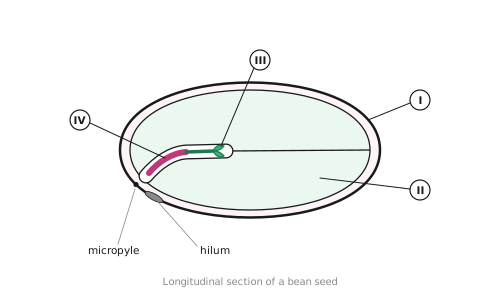 1234
1234Finger-like give the placenta a large surface area. Across it, oxygen and nutrients pass from the mother's blood to the foetus, and and urea pass back, though the two bloods do not . With a placenta, the foetus can stay in the to a later stage of development than in mammals without one.
Early studies found less coronary heart disease in women taking hormone replacement therapy, and took this as cause and effect. But it was only a : women on HRT tended to have a higher , which itself lowers the risk. Later, controlled trials showed that HRT slightly the risk.
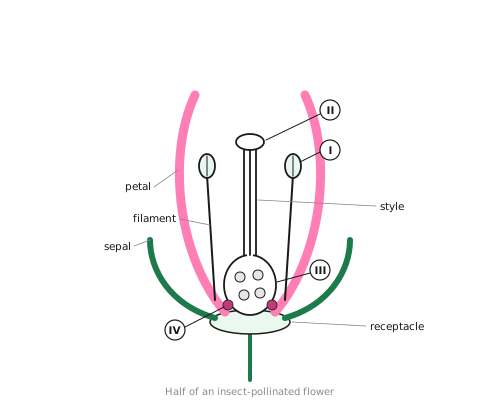 1234
1234| Hormone | Secreted by | Role |
|---|---|---|
| GnRH | its rise in late childhood boosts LH and FSH, so sex hormones bring on puberty | |
| hCG | the | keeps the corpus luteum secreting |
| Progesterone | corpus luteum, then the | keeps the uterus lining, so the pregnancy continues |
| Oxytocin | pituitary gland | rises once progesterone falls; contractions cause more release: feedback |
A pregnancy test detects hCG in urine with that bind to it.
| Asexual | Sexual | |
|---|---|---|
| Gametes | none | made by meiosis, then fused at fertilization |
| Offspring | genetically identical to the parent | new combinations of alleles |
| Best when the environment is | stable, and the parent already well adapted to it | changing, as variation lets some offspring adapt |
The male gamete travels to the female gamete, so it is much smaller, with fewer food reserves, and is made in far greater numbers.
Sperm and the fluid added to them leave together as semen, through the urethra. The fluid holds sugar for the sperm to respire and is alkaline, protecting sperm from the acid of the vagina.
About once a month an egg is released from a follicle: ovulation. If it is fertilized, the embryo develops in the uterus, whose muscular wall contracts to push the baby out at birth.
Late in the first half, a high level of an ovarian hormone triggers a surge of the pituitary hormones by positive feedback. After the egg is released, the empty follicle becomes the corpus luteum, and its hormones hold the pituitary hormones down by negative feedback. IVF suspends this natural cycle, then high hormone doses cause superovulation.
Each gamete brings one haploid set of 23 chromosomes.
Animals or wind carry pollen between plants. Plants promote cross-pollination: male and female parts ripen at different times, or sit in separate flowers or on separate plants, and in many species genetic self-incompatibility stops a plant fertilizing itself. Self-pollination would mean inbreeding, which lowers genetic diversity and vigour.
Carrying pollen is pollination; carrying seeds away from the parent, which cuts competition, is dispersal.
| Hormone | Secreted by | Role |
|---|---|---|
| GnRH | hypothalamus | its rise in late childhood boosts LH and FSH, so sex hormones bring on puberty |
| hCG | the embryo | keeps the corpus luteum secreting |
| Progesterone | corpus luteum, then the placenta | keeps the uterus lining, so the pregnancy continues |
| Oxytocin | pituitary gland | rises once progesterone falls; contractions cause more release: positive feedback |
A pregnancy test detects hCG in urine with monoclonal antibodies that bind to it.
| Spermatogenesis | Oogenesis | |
|---|---|---|
| Gametes per meiosis | four | one, plus small polar bodies |
| Cytoplasm | shared equally; most is lost as the sperm form | shared unequally, so the egg keeps nearly all of it |
| Gametes released | huge numbers, continually from puberty | usually one a month, from puberty to menopause |
Both begin with mitosis, then cell growth, the two divisions of meiosis and finally differentiation.
The cortical reaction prevents polyspermy: fertilization of one egg by more than one sperm.
Finger-like villi give the placenta a large surface area. Across it, oxygen and nutrients pass from the mother's blood to the foetus, and carbon dioxide and urea pass back, though the two bloods do not mix. With a placenta, the foetus can stay in the uterus to a later stage of development than in mammals without one.
Early studies found less coronary heart disease in women taking hormone replacement therapy, and took this as cause and effect. But it was only a correlation: women on HRT tended to have a higher socioeconomic status, which itself lowers the risk. Later, randomized controlled trials showed that HRT slightly increases the risk.