The subtopic in the middle and twelve tasks round it: label five diagrams, complete three tables, put a process in order and fill 68 gaps. Every standard level statement has a box; the three boxes for higher level only are dashed and badged HL, and drop off for an SL class. Type into the blanks and check them, or print it on A4, Letter or A3 with an answer key.
Paper
Each subtopic on a landscape page, as shuffled and chosen on screen.
D3.2
Inheritance
Organisms · Continuity and change
Hover over a box to see it. Untick it to leave it off this sheet and its printout.
Name
D3.2.2Crossing two plants
Number the steps in order.
Collect and sow the seeds that form: these plants are the F1 generation.
Brush pollen from the other parent onto their stigmas, then bag the flowers.
Sow their seeds to grow the F2 generation, and count each phenotype.
Let the F1 plants self-pollinate.
Remove the anthers from flowers of one parent before their pollen is ripe.
The two plants first crossed are the . A predicts the offspring of each cross. Breeders use crosses like these to make new crop varieties.
D3.2.13Reading a pedigree
1234
1
2
3
4
Unaffected parents have an affected daughter, so the condition must be and . Inferring a general pattern from some of the cases is reasoning; using that pattern to work out one person's genotype is reasoning. Close relatives often carry the same rare harmful alleles: the genetic reason many societies forbid them to marry.
D3.2.16, D3.2.17Two ways to line upHL
In meiosis I, the two homologues of each pair move to opposite poles, so the two alleles of a gene into different gametes. Each pair lines up at random, whatever the others do, so the alleles of unlinked genes show . Crossing AaBb with aabb therefore gives a phenotype ratio, and AaBb with AaBb a ratio.
D3.2.21Chi-squared on a crossHL
Phenotype
Observed
Expected
Round, yellow
94
Round, green
28
Wrinkled, yellow
27
Wrinkled, green
11
A dihybrid cross gave these 160 F2 offspring; the expected numbers follow a 9:3:3:1 ratio. χ² is about 0.71, with degrees of freedom. The critical value at p = 0.05 is 7.815, so the difference is not significant: the that the offspring fit the ratio is accepted.
D3.2.4, D3.2.6Nature and nurture
Phenotype comes from genotype and the . ABO blood group is set by genotype alone and a scar by injury alone, while adult height depends on . Developing traits that suit the conditions met, by changing which genes are , is . No alleles change, and the traits can be , as a suntan fades in winter.
D3.2.11, D3.2.12Sex chromosomes and haemophilia
Genotype
Phenotype
XᴴXᴴ
unaffected female
XᴴXʰ
XʰXʰ
XᴴY
unaffected male
XʰY
Every egg carries an X, so the sex chromosome in the decides whether the zygote develops male-typical or female-typical features. The Y carries far fewer genes than the X, so a recessive allele on a male's one X always shows. Sons get their X from their .
D3.2Inheritance
D3.2.14, D3.2.15Box and whiskers
12345
1
2
3
4
5
Like skin colour, height shows variation: it is , shaped by many genes, and affected by the environment. ABO blood group is a variable. A value more than × the IQR beyond the box is plotted on its own.
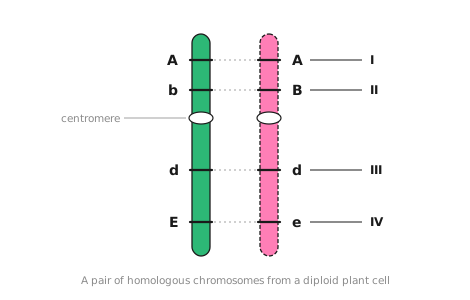
D3.2 examA pair of homologous chromosomes from a diploid plant cell
1234
1
2
3
4
D3.2.1, D3.2.3Passing genes on
Gametes are , carrying one copy of each gene. Two fuse into a zygote, with two copies of each autosomal gene, in every eukaryote that reproduces sexually. A gene's different versions are its alleles, and the combination of alleles an organism inherits is its . Two copies of the same allele: ; two different alleles: .
D3.2.5, D3.2.7, D3.2.10How alleles interact
Pattern
Heterozygote's phenotype
Example
Complete dominance
the same as the homozygous
phenylketonuria (PKU)
Codominance
a phenotype
blood group AB (IᴬIᴮ)
Incomplete dominance
an phenotype
pink four o'clock flowers (Mirabilis jalapa), from red × white
PKU is caused by a allele of an autosomal gene: without its enzyme, phenylalanine is not converted to . A heterozygote is healthy, as its one working allele makes enough enzyme.
D3.2.8, D3.2.9Two parents, four blood groups
1234
1
2
3
4
Alleles often differ by just one base: a single-nucleotide , or SNP. A gene pool can hold any number of alleles of one gene, as ABO holds three, called ; but each person inherits only .
D3.2.18, D3.2.19, D3.2.20Two genes, one chromosomeHL
12345
1
2
3
4
5
Genes close together on the same chromosome are : their alleles tend to pass into gametes together rather than assorting independently. New combinations need between the two genes, which is rarer the together they are.
Every box on the sheet with its gaps filled in, as the subtopic reads in full.
GapsPassing genes on
Gametes are haploid, carrying one copy of each gene. Two fuse into a diploid zygote, with two copies of each autosomal gene, in every eukaryote that reproduces sexually. A gene's different versions are its alleles, and the combination of alleles an organism inherits is its genotype. Two copies of the same allele: homozygous; two different alleles: heterozygous.
OrderCrossing two plants
Remove the anthers from flowers of one parent before their pollen is ripe.
Brush pollen from the other parent onto their stigmas, then bag the flowers.
Collect and sow the seeds that form: these plants are the F1 generation.
Let the F1 plants self-pollinate.
Sow their seeds to grow the F2 generation, and count each phenotype.
The two plants first crossed are the P generation. A Punnett grid predicts the offspring of each cross. Breeders use crosses like these to make new crop varieties.
GapsNature and nurture
Phenotype comes from genotype and the environment. ABO blood group is set by genotype alone and a scar by injury alone, while adult height depends on both. Developing traits that suit the conditions met, by changing which genes are expressed, is phenotypic plasticity. No alleles change, and the traits can be reversed, as a suntan fades in winter.
TableHow alleles interact
Pattern
Heterozygote's phenotype
Example
Complete dominance
the same as the homozygous dominant
phenylketonuria (PKU)
Codominance
a dual phenotype
blood group AB (IᴬIᴮ)
Incomplete dominance
an intermediate phenotype
pink four o'clock flowers (Mirabilis jalapa), from red × white
PKU is caused by a recessive allele of an autosomal gene: without its enzyme, phenylalanine is not converted to tyrosine. A heterozygote is healthy, as its one working allele makes enough enzyme.
LabelTwo parents, four blood groups
AB
B
A
O
Alleles often differ by just one base: a single-nucleotide polymorphism, or SNP. A gene pool can hold any number of alleles of one gene, as ABO holds three, called multiple alleles; but each person inherits only two.
TableSex chromosomes and haemophilia
Genotype
Phenotype
XᴴXᴴ
unaffected female
XᴴXʰ
carrier
XʰXʰ
affected female
XᴴY
unaffected male
XʰY
affected male
Every egg carries an X, so the sex chromosome in the sperm decides whether the zygote develops male-typical or female-typical features. The Y carries far fewer genes than the X, so a recessive allele on a male's one X always shows. Sons get their X from their mother.
LabelReading a pedigree
heterozygous
heterozygous
homozygous recessive
heterozygous
Unaffected parents have an affected daughter, so the condition must be recessive and autosomal. Inferring a general pattern from some of the cases is inductive reasoning; using that pattern to work out one person's genotype is deductive reasoning. Close relatives often carry the same rare harmful alleles: the genetic reason many societies forbid them to marry.
LabelBox and whiskers
first quartile
median
third quartile
maximum
outlier
Like skin colour, height shows continuous variation: it is polygenic, shaped by many genes, and affected by the environment. ABO blood group is a discrete variable. A value more than 1.5 × the IQR beyond the box is plotted on its own.
GapsTwo ways to line up HL
In meiosis I, the two homologues of each pair move to opposite poles, so the two alleles of a gene segregate into different gametes. Each pair lines up at random, whatever the others do, so the alleles of unlinked genes show independent assortment. Crossing AaBb with aabb therefore gives a 1:1:1:1 phenotype ratio, and AaBb with AaBb a 9:3:3:1 ratio.
LabelTwo genes, one chromosome HL
locus
parental
parental
recombinant
recombinant
Genes close together on the same chromosome are linked: their alleles tend to pass into gametes together rather than assorting independently. New combinations need crossing over between the two genes, which is rarer the closer together they are.
TableChi-squared on a cross HL
Phenotype
Observed
Expected
Round, yellow
94
90
Round, green
28
30
Wrinkled, yellow
27
30
Wrinkled, green
11
10
A dihybrid cross gave these 160 F2 offspring; the expected numbers follow a 9:3:3:1 ratio. χ² is about 0.71, with 3 degrees of freedom. The critical value at p = 0.05 is 7.815, so the difference is not significant: the null hypothesis that the offspring fit the ratio is accepted.
Exam diagramA pair of homologous chromosomes from a diploid plant cell
 Biology by Bradford
 1234
1234