The subtopic in the middle and eleven tasks round it: label three diagrams, complete three tables, put a process in order and fill 60 gaps. Every standard level statement has a box; the three boxes for higher level only are dashed and badged HL, and drop off for an SL class. Type into the blanks and check them, or print it on A4, Letter or A3 with an answer key.
Paper
Each subtopic on a landscape page, as shuffled and chosen on screen.
D4.2
Stability and change
Ecosystems · Continuity and change
Hover over a box to see it. Untick it to leave it off this sheet and its printout.
Name
D4.2.3The Amazon's rain machine
1234
1
2
3
4
Evaporation from the leaves the forest, and the water vapour is carried inland to fall again. Clear too much forest and this could fail, pushing the ecosystem past a ; how much forest is enough is still . A forest cut from 2000 km² to 1700 km² has changed by %.
D4.2.12, D4.2.13Early and late successionHL
In primary succession
Early
Late
Size of plants
small and low-growing
Primary production
high
Species diversity
low
Food webs
complex
Nutrient cycling
slow, in thin soil
Succession can be set off by a change in the environment or in biotic factors. The first colonists of bare ground, such as lichens, are .
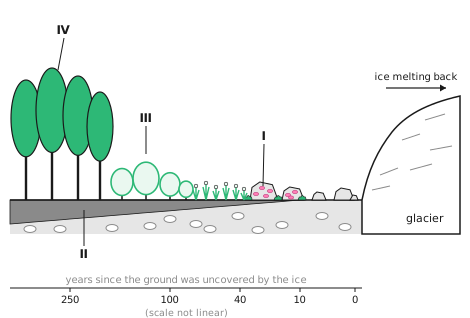
D4.2 examA profile of the ground in front of a glacierHL
1234
1
2
3
4
D4.2.1, D4.2.2Ecosystems that last
Some ecosystems, such as the Namib Desert, have kept much the same character for tens of millions of years: natural ecosystems tend to be . Staying that way takes a steady supply of , the of nutrients, enough for populations to adapt, and a climate that stays within the of the species living there.
D4.2.8Too many nutrients
Number the steps in order.
Bacteria decompose the dead matter, using up dissolved oxygen.
Algae grow fast in the enriched water and form a bloom.
The bloom shades the water beneath it, and plants and algae die.
Oxygen falls so low that fish and other animals die.
Rain leaches nitrate and phosphate fertilizers from farmland into rivers and lakes.
Nutrient enrichment like this is . As the decomposers multiply, the water's rises.
D4.2Stability and change
D4.2.9, D4.2.10Pollutants that persist
Pollutant
Why it lasts or builds up
Harm to wildlife
DDT
fat-soluble, so it is stored in fatty tissue rather than
thin eggshells in birds of prey
Mercury
taken in faster than it is lost, so levels are highest in top
damage to the nervous system
Macroplastic
, so it lasts for decades or longer
animals become or swallow it
Microplastic
fragments smaller than mm
eaten by plankton and filter feeders, passing up food chains
A toxin reaching a higher concentration at each step up a food chain is .
D4.2.14, D4.2.15Where succession stopsHL
In given conditions, succession tends to lead to one particular final community: the . People can stop it short, which is : by farm livestock stops grassland turning into woodland, and draining prevents their natural development. In some ecosystems there is no single end point, and communities replace one another in a repeating cycle, , as when old heather plants die back and the gap is colonised again.
D4.2.4A sealed world
1234
1
2
3
4
A is a small model ecosystem for testing how one variable affects its stability. A sealed glass vessel is better than an open tank: still passes through the glass, but no can enter or leave. Aquatic and systems tend to work better than terrestrial ones.
D4.2.5, D4.2.11Otters, wolves and rewilding
Sea otters eat the sea urchins that would otherwise graze a kelp forest bare, so the otter is a : its effect on the community is far bigger than its numbers. Remove such a species and the ecosystem may . Rewilding restores natural processes by bringing back , as wolves were returned to Yellowstone, by reconnecting habitats over large areas, and by keeping human low, as at Hinewai Reserve in New Zealand, where native forest is regrowing through introduced .
D4.2.6Harvest within limits
Harvesting from a wild population can go on indefinitely only if the rate of harvesting is than the rate of . A fish stock such as North Sea cod is assessed from survey catches, the ages of the fish landed and the catch per unit , and scientists advise catch . Where Brazil nuts are gathered, counting the shows whether enough new trees are growing up to replace the old ones.
D4.2.7Farming for the future
Factor
Why it threatens sustainability
Soil erosion
bare, ploughed is lost to wind and rain faster than it forms
Leaching
rain washes soluble below the roots and into rivers
Fertilizers and other inputs
phosphate rock is , and nitrogen fertilizer takes a lot of energy to make
Agrochemicals
kill species they were not aimed at and pollute water
Carbon footprint
machinery, fertilizer making and transport release
Every box on the sheet with its gaps filled in, as the subtopic reads in full.
GapsEcosystems that last
Some ecosystems, such as the Namib Desert, have kept much the same character for tens of millions of years: natural ecosystems tend to be stable. Staying that way takes a steady supply of energy, the recycling of nutrients, enough genetic diversity for populations to adapt, and a climate that stays within the tolerance of the species living there.
LabelThe Amazon's rain machine
transpiration
air flow
rain
deforestation
Evaporation from the leaves cools the forest, and the water vapour is carried inland to fall again. Clear too much forest and this could fail, pushing the ecosystem past a tipping point; how much forest is enough is still uncertain. A forest cut from 2000 km² to 1700 km² has changed by −15 %.
LabelA sealed world
light
seal
producer
consumer
A mesocosm is a small model ecosystem for testing how one variable affects its stability. A sealed glass vessel is better than an open tank: energy still passes through the glass, but no matter can enter or leave. Aquatic and microbial systems tend to work better than terrestrial ones.
GapsOtters, wolves and rewilding
Sea otters eat the sea urchins that would otherwise graze a kelp forest bare, so the otter is a keystone species: its effect on the community is far bigger than its numbers. Remove such a species and the ecosystem may collapse. Rewilding restores natural processes by bringing back apex predators, as wolves were returned to Yellowstone, by reconnecting habitats over large areas, and by keeping human impact low, as at Hinewai Reserve in New Zealand, where native forest is regrowing through introduced gorse.
GapsHarvest within limits
Harvesting from a wild population can go on indefinitely only if the rate of harvesting is lower than the rate of replacement. A fish stock such as North Sea cod is assessed from survey catches, the ages of the fish landed and the catch per unit effort, and scientists advise catch quotas. Where Brazil nuts are gathered, counting the seedlings shows whether enough new trees are growing up to replace the old ones.
TableFarming for the future
Factor
Why it threatens sustainability
Soil erosion
bare, ploughed topsoil is lost to wind and rain faster than it forms
Leaching
rain washes soluble nutrients below the roots and into rivers
Fertilizers and other inputs
phosphate rock is finite, and nitrogen fertilizer takes a lot of energy to make
Agrochemicals
pesticides kill species they were not aimed at and pollute water
Carbon footprint
machinery, fertilizer making and transport release greenhouse gases
OrderToo many nutrients
Rain leaches nitrate and phosphate fertilizers from farmland into rivers and lakes.
Algae grow fast in the enriched water and form a bloom.
The bloom shades the water beneath it, and plants and algae die.
Bacteria decompose the dead matter, using up dissolved oxygen.
Oxygen falls so low that fish and other animals die.
Nutrient enrichment like this is eutrophication. As the decomposers multiply, the water's biochemical oxygen demand rises.
TablePollutants that persist
Pollutant
Why it lasts or builds up
Harm to wildlife
DDT
fat-soluble, so it is stored in fatty tissue rather than excreted
thin eggshells in birds of prey
Mercury
taken in faster than it is lost, so levels are highest in top predators
damage to the nervous system
Macroplastic
non-biodegradable, so it lasts for decades or longer
animals become entangled or swallow it
Microplastic
fragments smaller than 5 mm
eaten by plankton and filter feeders, passing up food chains
A toxin reaching a higher concentration at each step up a food chain is biomagnification.
TableEarly and late succession HL
In primary succession
Early
Late
Size of plants
small and low-growing
large
Primary production
low
high
Species diversity
low
high
Food webs
simple
complex
Nutrient cycling
slow, in thin soil
fast
Succession can be set off by a change in the abiotic environment or in biotic factors. The first colonists of bare ground, such as lichens, are pioneer species.
GapsWhere succession stops HL
In given conditions, succession tends to lead to one particular final community: the climax community. People can stop it short, which is arrested succession: grazing by farm livestock stops grassland turning into woodland, and draining wetlands prevents their natural development. In some ecosystems there is no single end point, and communities replace one another in a repeating cycle, cyclical succession, as when old heather plants die back and the gap is colonised again.
Exam diagramA profile of the ground in front of a glacier HL
 Biology by Bradford
 1234
1234