The subtopic in the middle and twelve tasks round it: label three diagrams, complete two tables, put a process in order and fill 55 gaps. Every standard level statement has a box; the three boxes for higher level only are dashed and badged HL, and drop off for an SL class. Type into the blanks and check them, or print it on A4, Letter or A3 with an answer key.
Paper
Each subtopic on a landscape page, as shuffled and chosen on screen.
D4.3
Climate change
Ecosystems · Continuity and change
Hover over a box to see it. Untick it to leave it off this sheet and its printout.
Name
D4.3.4Polar habitats
1234
1
2
3
4
Emperor penguins raise their chicks on ice fixed to the Antarctic coast. If it breaks up , before the chicks have grown feathers, they drown or freeze. Arctic walruses rest on floating ice above shallow feeding grounds; as it shrinks, they crowd onto , far from their food.
D4.3.6On the move
As the climate warms, many species are shifting their ranges and . Birds of New Guinea's tropical mountains now live higher than they did in the 1960s, and those already near a summit have nowhere left to go. In North America many tree species' ranges are , while some are spreading .
D4.3.8Locking carbon away
Trees store carbon in their wood as they grow. Planting forest on land that has not recently been forested is ; letting cleared forest grow back is forest . Scientists still debate whether plantations of introduced trees or rewilding with species lock away more carbon. Restoring wetlands helps too: in soil, lack of oxygen stops dead plants decomposing fully, so their carbon builds up as .
D4.3.9, D4.3.10Out of stepHL
Population
Main cue
When spring is warmer
Arctic mouse-ear chickweed
grows and peaks sooner
Migrating reindeer
arrive on the usual date, after the plants' peak
Caterpillars in oak woods
reach peak biomass sooner
Great tit
chicks hatch after the caterpillar peak, so survive
Research into the timing of events such as budburst, flowering, migration and nesting is . Where two populations in one ecosystem respond to different cues, warming can break their .
D4.3.1Reading the ice
Burning and clearing forests have raised carbon dioxide far above anything in the ice-core record, and cattle, rice paddies and landfill add . Antarctic ice cores show a correlation between CO₂ and temperature over 400 000 years. A correlation alone does not prove , but other evidence confirms that CO₂ warms the climate.
D4.3.7Reefs at risk
Corals build reefs from calcium carbonate. Dissolved CO₂ makes seawater more acidic, , leaving fewer carbonate ions, so is suppressed. Water that is too warm makes corals expel the living in their tissues, and they turn white: . Without them the corals starve, and the whole reef ecosystem can .
D4.3Climate change
D4.3.5Ocean food supply
123
1
2
3
Shifting ocean currents change when and where cold, deep water reaches the surface. Warmer surface water, being less , floats on the cold water below and can stop it rising altogether. Then there is less at the surface, and less flows through marine food chains.
D4.3.11Beetles speed upHL
Warmer summers speed up the development of the spruce bark beetle, so more fit into one year: where there was one, there can now be . Its numbers can then climb much faster, and spruce trees weakened by resist attack poorly, so outbreaks kill trees over huge areas.
D4.3.2Warming that feeds itself
Warming makes...
...which adds to warming because
the deep ocean warm
warmer water holds dissolved CO₂, so it escapes to the air
snow and ice melt
darker land and water more solar radiation instead of reflecting it
permafrost thaw
and CO₂ escape from long-frozen organic matter
peat dry and warm
speeds up and releases its stored carbon
droughts more common
more forest burn, releasing carbon
Each is a cycle: warming sets off a change that causes more warming.
D4.3.3Taiga in trouble
Number the steps in order.
Warmer temperatures and less winter snow leave the forest short of water.
Stressed trees turn brown and die back.
Fires burn legacy carbon that built up in the soil over centuries.
Droughts become more frequent and primary production falls.
The forest switches from net carbon accumulation to net carbon loss.
Forest fires become more frequent and more intense.
Once a boreal forest gives out more carbon than it takes in, it has passed a .
D4.3.12Tawny owl coloursHL
Tawny owls are grey or brown, and the colour is . In cold, snowy winters the grey ones survive better. As Finnish winters have brought less snow, the of the other colour has risen, and the proportion of owls has gone up: as a consequence of climate change.
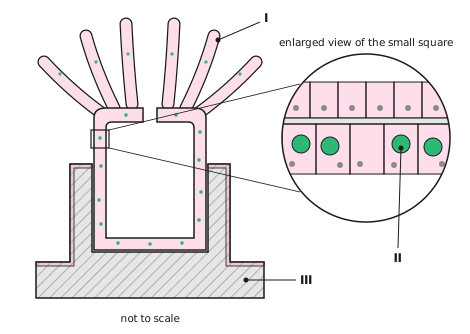
D4.3 examA vertical section through a single polyp of a reef-building
Every box on the sheet with its gaps filled in, as the subtopic reads in full.
GapsReading the ice
Burning fossil fuels and clearing forests have raised carbon dioxide far above anything in the ice-core record, and cattle, rice paddies and landfill add methane. Antarctic ice cores show a positive correlation between CO₂ and temperature over 400 000 years. A correlation alone does not prove causation, but other evidence confirms that CO₂ warms the climate.
TableWarming that feeds itself
Warming makes...
...which adds to warming because
the deep ocean warm
warmer water holds less dissolved CO₂, so it escapes to the air
snow and ice melt
darker land and water absorb more solar radiation instead of reflecting it
permafrost thaw
methane and CO₂ escape from long-frozen organic matter
peat dry and warm
decomposition speeds up and releases its stored carbon
droughts more common
more forest fires burn, releasing carbon
Each is a positive feedback cycle: warming sets off a change that causes more warming.
OrderTaiga in trouble
Warmer temperatures and less winter snow leave the forest short of water.
Droughts become more frequent and primary production falls.
Stressed trees turn brown and die back.
Forest fires become more frequent and more intense.
Fires burn legacy carbon that built up in the soil over centuries.
The forest switches from net carbon accumulation to net carbon loss.
Once a boreal forest gives out more carbon than it takes in, it has passed a tipping point.
LabelPolar habitats
landfast ice
emperor penguin
sea ice
walrus
Emperor penguins raise their chicks on ice fixed to the Antarctic coast. If it breaks up early, before the chicks have grown waterproof feathers, they drown or freeze. Arctic walruses rest on floating ice above shallow feeding grounds; as it shrinks, they crowd onto land, far from their food.
LabelOcean food supply
phytoplankton
nutrients
upwelling
Shifting ocean currents change when and where cold, deep water reaches the surface. Warmer surface water, being less dense, floats on the cold water below and can stop it rising altogether. Then there is less primary production at the surface, and less energy flows through marine food chains.
GapsOn the move
As the climate warms, many species are shifting their ranges poleward and upslope. Birds of New Guinea's tropical mountains now live higher than they did in the 1960s, and those already near a summit have nowhere left to go. In North America many tree species' ranges are contracting, while some are spreading north.
GapsReefs at risk
Corals build reefs from calcium carbonate. Dissolved CO₂ makes seawater more acidic, ocean acidification, leaving fewer carbonate ions, so calcification is suppressed. Water that is too warm makes corals expel the zooxanthellae living in their tissues, and they turn white: bleaching. Without them the corals starve, and the whole reef ecosystem can collapse.
GapsLocking carbon away
Trees store carbon in their wood as they grow. Planting forest on land that has not recently been forested is afforestation; letting cleared forest grow back is forest regeneration. Scientists still debate whether plantations of introduced trees or rewilding with native species lock away more carbon. Restoring wetlands helps too: in waterlogged soil, lack of oxygen stops dead plants decomposing fully, so their carbon builds up as peat.
TableOut of step HL
Population
Main cue
When spring is warmer
Arctic mouse-ear chickweed
temperature
grows and peaks sooner
Migrating reindeer
photoperiod
arrive on the usual date, after the plants' peak
Caterpillars in oak woods
temperature
reach peak biomass sooner
Great tit
photoperiod
chicks hatch after the caterpillar peak, so fewer survive
Research into the timing of events such as budburst, flowering, migration and nesting is phenology. Where two populations in one ecosystem respond to different cues, warming can break their synchrony.
GapsBeetles speed up HL
Warmer summers speed up the development of the spruce bark beetle, so more life cycles fit into one year: where there was one, there can now be two. Its numbers can then climb much faster, and spruce trees weakened by drought resist attack poorly, so outbreaks kill trees over huge areas.
GapsTawny owl colours HL
Tawny owls are grey or brown, and the colour is heritable. In cold, snowy winters the grey ones survive better. As Finnish winters have brought less snow, the fitness of the other colour has risen, and the proportion of brown owls has gone up: evolution as a consequence of climate change.
Exam diagramA vertical section through a single polyp of a reef-building
 Biology by Bradford
 123
123