C2.2.1, C2.2.3, C2.2.4A neuron
12345
- 1
- 2
- 3
- 4
- 5
Nerve impulses are that travel along the fibres. They are electrical because they are movements of positively charged .
 Biology by Bradford
support
Biology by Bradford
support
The subtopic in the middle and twelve tasks round it: label six diagrams, complete two tables, put a process in order and fill 65 gaps. Every standard level statement has a box; the six boxes for higher level only are dashed and badged HL, and drop off for an SL class. Type into the blanks and check them, or print it on A4, Letter or A3 with an answer key.
Nerve impulses are that travel along the fibres. They are electrical because they are movements of positively charged .
Number the steps in order.
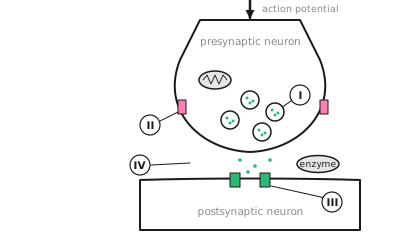
A small depolarization of the postsynaptic membrane like this is an . Acetylcholine works at many synapses, including the between motor neurons and muscle fibres.
| Excitatory synapse | Inhibitory synapse | |
|---|---|---|
| Ions that move | Na⁺ diffuses in | Cl⁻ diffuses in, or K⁺ out |
| Postsynaptic membrane is | ||
| Potential produced | EPSP | |
| An action potential is | more likely |
One postsynaptic neuron may receive many presynaptic neurons, and their effects are added together: . Only if the total reaches the does an action potential start, all or nothing.
Free nerve endings in the skin have channels for ions that open in response to heat, acid or , the chemical that makes chillies hot. Ions flood in, the is reached, and impulses travel to the , where pain is felt. Consciousness is an property: it arises from the interactions of billions of neurons, and no single neuron has it.
Across non-myelinated fibres, wider axons carry impulses faster: a correlation, with the correlation coefficient r close to . If R² = 0.81, then % of the variation in speed is explained by variation in axon diameter. So the , with axons up to 1 mm wide, sends impulses at about 25 m/s, against about 1 m/s in thin non-myelinated fibres. Myelinated fibres are faster still: a human one only 20 µm wide conducts at up to 120 m/s.
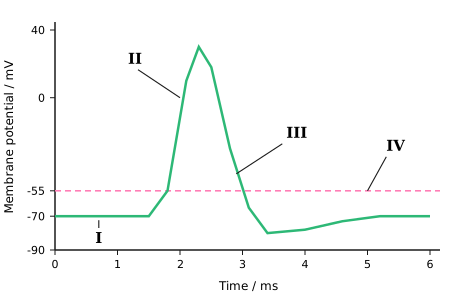
On the way up, voltage-gated channels are open; on the way down, voltage-gated channels. A trace from a neuron firing again and again lets you count the per second.
Neonicotinoid pesticides bind tightly to receptors in the synapses of insects and are not broken down, so synaptic transmission is ; the insect is paralysed and dies. Cocaine stops the of into presynaptic neurons, so it stays in the cleft and keeps exciting the postsynaptic neuron.
 1234
1234| Sodium ions (Na⁺) | Potassium ions (K⁺) | |
|---|---|---|
| Pumped | ||
| Number moved for each ATP used | ||
| Higher concentration | outside the neuron | inside the neuron |
| Leaking back at rest | very little | more, through open channels |
So the inside sits at about mV compared with the outside: the membrane is , and this is the .
Synapses link neurons to other neurons and to cells such as muscle fibres and gland cells. A signal can cross a synapse in only direction.
Ion pumps and channels are clustered where the axon membrane is bare, so the action potential jumps from one bare patch to the next: conduction, far than in a fibre without this insulation. Sodium ions diffusing along the axon, inside towards the next patch and outside away from it, bring that patch to the .
 1234
1234Nerve impulses are action potentials that travel along the fibres. They are electrical because they are movements of positively charged ions.
| Sodium ions (Na⁺) | Potassium ions (K⁺) | |
|---|---|---|
| Pumped | out | in |
| Number moved for each ATP used | 3 | 2 |
| Higher concentration | outside the neuron | inside the neuron |
| Leaking back at rest | very little | more, through open channels |
So the inside sits at about −70 mV compared with the outside: the membrane is polarized, and this is the resting potential.
Across non-myelinated fibres, wider axons carry impulses faster: a positive correlation, with the correlation coefficient r close to +1. If R² = 0.81, then 81 % of the variation in speed is explained by variation in axon diameter. So the squid, with axons up to 1 mm wide, sends impulses at about 25 m/s, against about 1 m/s in thin non-myelinated fibres. Myelinated fibres are faster still: a human one only 20 µm wide conducts at up to 120 m/s.
Synapses link neurons to other neurons and to effector cells such as muscle fibres and gland cells. A signal can cross a synapse in only one direction.
A small depolarization of the postsynaptic membrane like this is an excitatory postsynaptic potential. Acetylcholine works at many synapses, including the neuromuscular junctions between motor neurons and muscle fibres.
On the way up, voltage-gated sodium channels are open; on the way down, voltage-gated potassium channels. A trace from a neuron firing again and again lets you count the impulses per second.
Ion pumps and channels are clustered where the axon membrane is bare, so the action potential jumps from one bare patch to the next: saltatory conduction, far faster than in a fibre without this insulation. Sodium ions diffusing along the axon, inside towards the next patch and outside away from it, bring that patch to the threshold.
| Excitatory synapse | Inhibitory synapse | |
|---|---|---|
| Ions that move | Na⁺ diffuses in | Cl⁻ diffuses in, or K⁺ out |
| Postsynaptic membrane is | depolarized | hyperpolarized |
| Potential produced | EPSP | IPSP |
| An action potential is | more likely | less likely |
One postsynaptic neuron may receive many presynaptic neurons, and their effects are added together: summation. Only if the total reaches the threshold does an action potential start, all or nothing.
Neonicotinoid pesticides bind tightly to acetylcholine receptors in the synapses of insects and are not broken down, so synaptic transmission is blocked; the insect is paralysed and dies. Cocaine stops the reuptake of dopamine into presynaptic neurons, so it stays in the cleft and keeps exciting the postsynaptic neuron.
Free nerve endings in the skin have channels for positive ions that open in response to heat, acid or capsaicin, the chemical that makes chillies hot. Ions flood in, the threshold is reached, and impulses travel to the brain, where pain is felt. Consciousness is an emergent property: it arises from the interactions of billions of neurons, and no single neuron has it.